



Key Takeaways
- Kajabi is a creator commerce platform. It lacks SCORM support (per their own Help Center), native DRM, multi-batch management, and B2B architecture. Training businesses need a different category of tool.
- The January 2026 price hike removed the Kickstarter plan, raised Basic to $179/month, and cut contact limits. Branded apps require the $399/month Pro plan.
- Edmingle is the strongest alternative for training businesses: 0% transaction fees, native multi-batch ops, sub-organizations, training automations, AI-powered features including a Robust AI Companion (Learning Assistant), Mettl + Examonline proctoring, SCORM from ₹14,999/month, branded apps included, and both USD and INR pricing.
- For interactive video: LearnWorlds. Corporate L&D: TalentLMS. Community-first: Mighty Networks. Budget creators: Systeme.io. Exam prep: Learnyst.
- Always calculate total cost of ownership. Kajabi Pro ($399/month) still lacks SCORM, DRM, and multi-batch. Adding third-party tools pushes the real cost above $500/month.
- Kajabi has a low BBB rating with multiple unresponded complaints. Trustpilot shows 'Cancellation' and 'Subscription' as the top negative tags.
Kajabi is a powerful creator commerce platform. It has helped over 100,000 creators earn $10B+ collectively, and for solo coaches selling courses, memberships, and podcasts from a single dashboard, it genuinely delivers.
But Kajabi’s January 2026 pricing overhaul sent thousands of creators looking for the exit. The Kickstarter plan was removed from public pricing. Basic jumped to $179/month. Contact limits on Basic were slashed from 10,000 to 2,500. The backlash triggered a Change.org petition and widespread frustration in creator communities.
Here is the thing most Kajabi alternatives miss: if you are running a training business, Kajabi was never the right tool in the first place. It lacks SCORM support (confirmed by Kajabi’s own Help Center), has zero native DRM, cannot handle multi-batch scheduling, and offers nothing for B2B delivery or sub-organizations. The branded app is locked behind the $399/month Pro plan. Kajabi was built for a different buyer.
In this guide, we compare the 9 best Kajabi alternatives for training businesses. We cover what each platform does well, where it falls short, how it compares to Kajabi on features and pricing, and which type of business it actually fits. If you already know you need a training operations platform, you can skip straight to the Edmingle section or explore Edmingle features directly.
Why Training Businesses Outgrow Kajabi
Before looking at alternatives, here are the specific reasons training businesses hit the wall on Kajabi. These come from reviewing Kajabi’s official Help Center, the Ruzuku 2026 analysis, 280+ Capterra reviews (4.4/5), G2 (~4.5/5), and the BBB complaint record.
SCORM Support Is a Confirmed Exclusion
From Kajabi’s own Help Center: ‘Kajabi does not support LMS formats like SCORM or HTML5 files.’ This is confirmed and absent from any public roadmap. If your corporate clients require SCORM compliance reports, Kajabi cannot serve you. Platforms like Edmingle offer SCORM from the Prime plan (₹14,999/month), and TalentLMS includes it on every plan.
Branded App Requires the $399/Month Pro Plan
Kajabi’s branded mobile app is only available on the Pro plan at $399/month (annual) or $499/month (monthly). The Growth plan ($199/month) does not include it at any price, which means you are paying nearly twice the Growth price before you can put your own brand on a mobile experience. On Edmingle, branded Android apps are included from the Prime plan (₹14,999/month) and branded iOS from Power (₹29,999/month), with no separate add-on fee.
DRM Content Protection Is Missing
Kajabi has no built-in DRM for video content. Any learner with screen recording software can capture your premium courses without restriction. Adding DRM requires a third-party service like VdoCipher at additional monthly cost. Edmingle includes advanced DRM and watermarking natively, so your video content is protected from day one without any integration overhead.
Missing Multi-Batch and B2B Architecture
Kajabi is designed for one creator serving one audience. It lacks native multi-batch scheduling (running the same program for 3 cohorts simultaneously), sub-organizations for franchise or corporate client delivery, and consolidated parent-level reporting. The Pro plan allows 3 websites, but they share the same database, which means you cannot truly isolate client environments. For training businesses running concurrent cohorts with multiple instructors, this architecture creates operational bottlenecks that workarounds cannot solve.
Hidden Surcharges on Payments
According to the Ruzuku pricing analysis and Kajabi’s own help documentation, several surcharges apply beyond the headline subscription price. Basic plan users pay a 2% surcharge if using their own Stripe account (1% on Growth, 0.5% on Pro). Every subscription or payment plan transaction carries an additional 0.7% fee. Afterpay transactions incur 6% + $0.30, and Klarna carries 5.99% + $0.30. International card transactions add another 1.5%. For a training business running memberships at scale, the effective processing rate can reach approximately 3.6% + $0.30 per transaction depending on your mix of Stripe, Afterpay/Klarna, and international cards, well above the headline 2.9% rate.
Support Quality Is Declining
Kajabi has a low BBB rating with multiple complaints on file, a significant number of which went unresponded. On Trustpilot (4.3/5, declining from 4.6), ‘Cancellation’ and ‘Subscription’ are the most common negative tags across reviews. Multiple reviewers describe AI chatbots replacing human agents, extended multi-hour chats without resolution, and billing disputes handled dismissively. A recent Capterra review from an L&D professional highlighted that access restrictions during billing disputes caused direct operational disruption.
Note: Kajabi is a strong platform for solo creators who use its full feature set (courses, memberships, podcasts, newsletters, funnels) and are comfortable with USD-only pricing. The limitations above specifically affect training businesses with operational complexity beyond single-creator delivery.
Quick Buyer-Fit Test: Creator Tool or Training Ops Platform?
Every page ranking for ‘kajabi alternative’ speaks to solo creators. This is the only guide that addresses the training business buyer who ended up on Kajabi because it looked like it could do everything. Take this 5-question test to determine whether your business needs a creator tool or a training operations platform:
| Question | Yes / No |
| Do you have more than 2 instructors delivering training? | |
| Do you run the same program for multiple cohorts at once? | |
| Do your clients require SCORM compliance reports? | |
| Do you serve both B2B and B2C from one platform? | |
| Do you need learner analytics beyond ‘course completed’? |
If you answered yes to 3 or more, Kajabi was not designed for your use case. That is not a knock on the platform. It is an honest assessment of what it was built to do. With that context established, let us look at the 9 best Kajabi alternatives.
Kajabi Competitors: Feature Comparison at a Glance
Before diving into the detailed breakdown, here is a snapshot of how all 9 alternatives compare on the features that matter most for training businesses.
| Feature | Edmingle | Thinkific | Teachable | LearnWorlds | TalentLMS | Podia | Mighty N. | Systeme | Learnyst |
| Multi-Batch | Yes, native | No | No | No | Limited | No | No | No | Partial |
| Sub-Orgs | Yes (Power+) | No | No | No | No | No | No | No | No |
| SCORM | Yes (Prime+) | Plus only | No | LC plan | Yes | No | No | No | Yes |
| DRM | Yes, advanced | No | No | No | No | No | No | No | Yes, L3 |
| Branded Apps | Included | $199/mo | No | Add-on | Ent. only | No | Higher | No | Yes |
| Mktg Auto. | Yes, deep | Limited | No | Limited | Limited | Limited | Limited | Yes | Limited |
| Analytics | Advanced | Limited | Limited | Limited | Limited | Limited | Limited | Limited | Limited |
| Tx Fees | 0% | 0-5% | 7.5%* | $5/sale* | N/A | 5%/0% | 1-3% | 0% | 0% |
| India Pay | Yes | No | No | No | No | No | No | No | Yes |
| AI Features | AI-Powered + AI Companion | Limited | No | Limited | TalentCraft | No | Limited | No | Limited |
| Proctoring | Mettl + Examonline | No | No | No | No | No | No | No | No |
| Community | Built-in | Limited | No | Yes | Limited | Yes | Yes, core | Yes | Yes |
| Free Plan | 7-day trial | 30-day | 7-day | 30-day | Yes (5) | 30-day | 14-day | Yes | Trial |
* Varies by plan tier. See individual platform sections for details.
1. Edmingle

Founded: 2017 (Ascorb Technologies, Bengaluru)
Most similar to: Graphy, Learnyst, LearnWorlds, Thinkific
Typical users: Training business operators, program managers, founders
Typical customers: Job-skilling academies, certification providers, exam prep, B2B training companies
What Is Edmingle?
Edmingle is an AI-powered training operations platform purpose-built for professional training and skilling businesses. If Kajabi is a creator commerce platform designed around monetizing an audience, Edmingle is the operational backbone for training companies that run multi-batch programs, manage multiple instructors, and serve both B2C learners and B2B corporate clients from a single platform. Customers include McGraw Hill Education India, Career247, Learnbay, Aditya Birla Education Academy, LawSikho, ISKCON, and Chegg India. See customer case studies for detailed results.
Key Features
- Multi-batch management: Run multiple cohorts of the same program concurrently with per-batch scheduling, instructor assignment, and attendance tracking across all plans.
- Sub-organizations: Create separate white-label instances for franchise partners or corporate clients with consolidated parent-level reporting, available on Power plan and above.
- SCORM support: Available from the Prime plan (₹14,999/month), which is significant because Kajabi does not support SCORM at any price point.
- Advanced DRM and watermarking: Screen-capture restrictions and multi-device controls built natively into the platform, eliminating the need for third-party integrations like VdoCipher.
- Advanced learner analytics: Real-time DAU/MAU tracking, engagement health scoring (Healthy, Passive, Unengaged), activity heatmaps, and course-level drop-off curves that go well beyond Kajabi’s basic completion tracking.
- AI-powered features: AI-driven feedback/sentiment analysis (Prime+), advanced AI learner analytics (Power+), and a Robust AI Companion (Learning Assistant) in development. Edmingle is the only platform building this depth of learner intelligence for training businesses.
- Proctoring integrations: Mettl and Examonline, available from the Power plan onwards.
- Marketing automation: Advanced workflows including abandoned cart recovery, dormant learner re-engagement sequences, dynamic segments, and scheduled campaigns.
- Branded mobile apps: Included in the plan (Android from Prime at ₹14,999/month, iOS from Power at ₹29,999/month) rather than being locked behind a top-tier subscription.
- Coding assessments: Built-in compiler for programming assignments, which is critical for job-skilling academies running developer training programs.
- 0% transaction fees with no hidden costs. 15-day money-back guarantee on all plans.
How Does Edmingle Compare to Kajabi?
| Feature | Edmingle | Kajabi |
| Free trial | Yes, 7-day (no credit card) | 14-day (credit card required) |
| Multi-batch management | Yes, native (all plans) | Not available |
| Sub-organizations (B2B) | Yes (Power+) | Not available |
| SCORM support | Yes (Prime+, ₹14,999/mo) | Not supported (per Help Center) |
| DRM / Content protection | Yes, Advanced DRM + watermarking | Not available |
| AI Features | AI-Powered: feedback analysis, learner analytics, AI Companion (in dev) | AI course outline, email, video dubbing |
| Proctoring | Mettl + Examonline (Power+) | Not available |
| Branded mobile apps | Included (Prime ₹14,999/mo) | Pro only ($399/mo) |
| Marketing automation | Yes, deep (workflows, segments) | Yes, strong (funnels, email) |
| Learner analytics depth | Advanced (engagement scoring) | Basic (completion only) |
| Transaction fees | 0% on all plans | 0% Kajabi Pay; 0.5-2% surcharge w/ Stripe |
| API access | Core+ (₹7,499/mo) | Pro only ($399/mo) |
| Pricing (entry, annual) | ₹7,499/mo (Core) | $143/mo (Basic) |
| Pricing (mid, annual) | ₹14,999/mo (Prime) | $199/mo (Growth) |
| Pricing (top, annual) | ₹29,999/mo (Power) | $399/mo (Pro) |
| Podcast hosting | Not available | Yes |
| Newsletter monetization | Not available | Yes |
Main Differences Between Edmingle and Kajabi
- Edmingle supports SCORM from ₹14,999/month (Prime plan). Kajabi does not support SCORM at any price, which is confirmed by their own Help Center documentation.
- Edmingle includes branded mobile apps in the plan starting from ₹14,999/month. Kajabi locks branded apps behind the $399/month Pro plan, effectively doubling the cost for this capability.
- Edmingle includes native advanced DRM and watermarking built into the platform. Kajabi lacks native DRM entirely, requiring third-party services like VdoCipher at additional cost.
- Kajabi has meaningfully stronger sales funnel tools, podcast hosting, and newsletter monetization capabilities. These are creator-commerce features that Edmingle does not prioritize because its architecture focuses on training operations instead.
- Edmingle is AI-powered, with live features including AI-driven feedback analysis and learner analytics, plus the Robust AI Companion (Learning Assistant) and AI Assessment Evaluator in development. Kajabi’s AI focuses on creator-facing content tools (video dubbing, email copy).
- Edmingle offers API access from the Core plan (₹7,499/month). Kajabi gates API access behind the Pro plan ($399/month), which limits integration flexibility on lower tiers.
Main Similarities Between Edmingle and Kajabi
- Both offer course creation tools with multimedia support, community features, and marketing capabilities.
- Both support cohort-style delivery, though Edmingle’s multi-batch architecture is significantly deeper than Kajabi’s cohort courses.
- Both offer branded mobile apps, albeit at different price points and with different inclusion models.
- Both platforms serve their respective buyer types well. The distinction is between creator commerce and training operations.
Why Do Training Businesses Choose Edmingle?
Based on customer evidence and platform capabilities, training businesses choose Edmingle for three primary reasons:
- SCORM as a non-negotiable requirement: Training businesses with corporate clients or certification programs need SCORM compliance. Kajabi cannot provide it at any tier. Edmingle includes it from the Prime plan at ₹14,999/month, which makes it accessible without top-tier pricing.
- Total cost of ownership advantage: Kajabi Pro ($399/month) provides a branded app, API access, and strong marketing tools, but it still lacks SCORM, DRM, multi-batch management, and advanced learner analytics. To replicate what Edmingle Power (₹29,999/month) includes natively, a Kajabi user would need to add VdoCipher for DRM, a separate SCORM-compliant LMS, and an analytics tool, pushing the real monthly cost well above $500.
Explore Edmingle pricing to compare plans and features side by side.
- Operational depth for structured training: Multi-batch scheduling, sub-organizations for B2B delivery, trainer analytics, proctored exams via Mettl and Examonline, and coding assessments with a built-in compiler are all native to Edmingle. The platform is also AI-powered, with AI feedback analysis, advanced learner analytics, and a Robust AI Companion in development that no other platform offers at this depth. These capabilities exist because Edmingle was designed for training operations from the ground up, rather than being retrofitted onto a creator commerce platform.
Bottom Line
Edmingle occupies a different category than Kajabi. For training businesses that need SCORM, DRM, multi-batch ops, and sub-organizations, Edmingle delivers what Kajabi structurally cannot provide, at a lower price point (₹29,999/month versus $399/month for the top tier). It is available in both INR and USD pricing, serving training businesses in over 100 countries. All plans include a 15-day money-back guarantee.
Must Read: See the full feature-by-feature breakdown in our Edmingle vs Kajabi comparison.
2. Thinkific
Founded: 2012
Most similar to: Teachable, LearnWorlds, Kajabi
Typical users: Solo course creators, hobbyists, solopreneurs
Typical customers: Individual creators in Western markets selling 1 to 5 courses
What Is Thinkific?
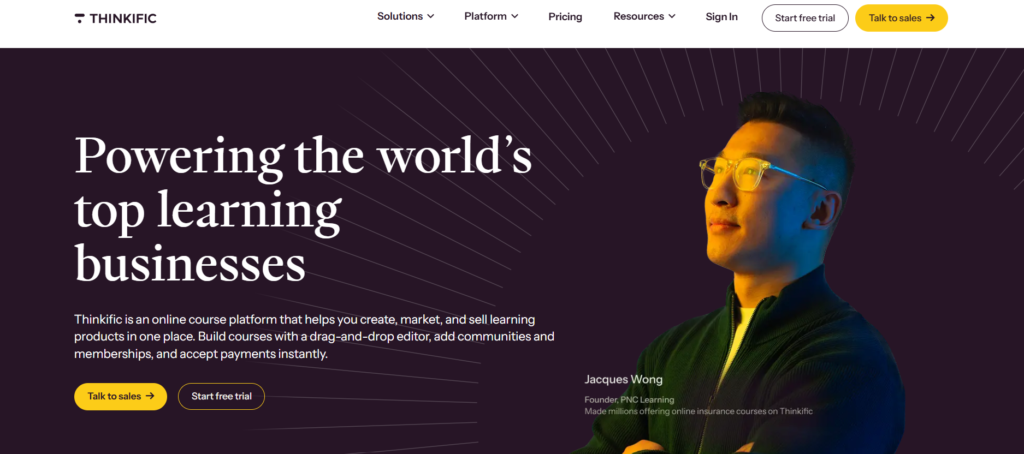
Thinkific is a course platform built for solo creators who want an intuitive builder and an affordable entry point. It discontinued its free plan in 2025, replacing it with a 30-day free trial, but the Basic plan at around $39/month (annual) remains one of the cheaper options in the market. For a detailed breakdown, see our Edmingle vs Thinkific comparison.
Key Features
- Course builder: Drag-and-drop interface with multimedia support (video, PDF, audio, presentations).
- AI tools: Course outline generator and AI-powered landing page builder to speed up launch.
- Thinkific Payments: 0% transaction fees when using their native payment processor. Using your own Stripe or PayPal incurs a 1 to 5% surcharge depending on plan.
- Community: Basic community features integrated alongside courses on paid plans.
- SCORM: Available only on the Plus plan, which requires custom pricing and a sales conversation.
How Does Thinkific Compare to Kajabi?
| Feature | Thinkific | Kajabi |
| SCORM | Plus plan only (custom pricing) | Not supported |
| DRM | Not available (requires VdoCipher) | Not available |
| Branded mobile app | $199/mo add-on on top of plan | Pro only ($399/mo) |
| Entry price (annual) | ~$39/mo (Basic) | $143/mo (Basic) |
| Marketing funnels | Limited (basic email, landing pages) | Yes, strong (pipelines, automations) |
| Podcast hosting | Not available | Yes |
| Community | Limited | Yes |
| Student cap | 10,000 on standard plans | Varies by plan |
| AI tools | Course outline, landing page | Course outline, email, video dubbing |
Main Differences Between Thinkific and Kajabi
- Thinkific is significantly cheaper to get started at $36/month versus Kajabi’s $143/month entry point, which makes it more accessible for creators on a budget.
- Kajabi has considerably stronger marketing automation, sales funnels, and email tools. Thinkific’s marketing capabilities are basic by comparison.
- Thinkific offers SCORM on its highest-tier Plus plan. Kajabi does not support SCORM at any price.
- Thinkific caps students at 10,000 on standard plans. Kajabi does not impose hard student caps.
- Thinkific’s branded mobile app costs $199/month as a separate add-on. Kajabi’s branded app is included on Pro ($399/month) but unavailable on lower plans.
Main Similarities Between Thinkific and Kajabi
- Both are creator-focused course platforms designed for individuals selling courses to an audience.
- Both lack native DRM, requiring third-party integrations for video content protection.
- Neither offers multi-batch management or sub-organization architecture for B2B delivery.
- Both offer community features and AI-assisted course creation tools.
Why Do Companies Use Thinkific?
According to G2 reviews (4.5/5, as of mid-2026), companies choose Thinkific for three main reasons:
- Affordable entry point: At around $39/month, Thinkific is one of the cheapest ways to start selling courses online, and reviewers consistently cite price as a primary reason for choosing it.
- Intuitive course builder: Non-technical users appreciate the drag-and-drop interface and the ability to launch a course without developer help.
- Clean student experience: Reviewers praise the distraction-free learner interface that keeps students focused on the content.
Bottom Line
Thinkific is the strongest budget option for solo creators launching their first few courses. Its Trustpilot rating (~2.7/5 as of mid-2026) flags billing and support concerns worth investigating before committing. Training businesses will find it limiting: it lacks DRM, charges $199/month for a branded app, and caps students at 10,000 on standard plans.
3. Teachable
Founded: 2014
Most similar to: Thinkific, Kajabi, Podia
Typical users: Solo creators, coaches, authors
Typical customers: Individual course creators primarily in Western markets
What Is Teachable?
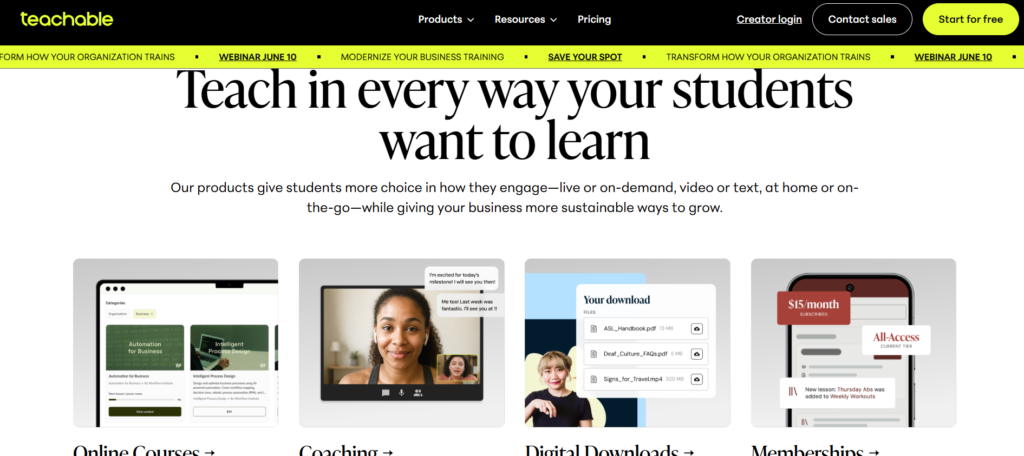
Teachable was a pioneer in making online course creation accessible to non-technical creators. Acquired by Hotmart in 2020, it has since gone through multiple pricing restructures that have frustrated long-time users. Named creators like Kerstin Cable and Andrea Jones have publicly documented leaving the platform. For a detailed comparison, see our Edmingle vs Teachable analysis.
Key Features
- Course builder: Straightforward drag-and-drop editor praised for ease of use across most reviews.
- Affiliate program: One of the strongest affiliate marketing tools in the creator platform space, available on Builder plans and above.
- Payment plans: Installment options for higher-priced courses that help increase conversion on premium programs.
- Student management: Basic enrollment tracking, student communications, and completion certificates.
How Does Teachable Compare to Kajabi?
| Feature | Teachable | Kajabi |
| SCORM | Not supported | Not supported |
| DRM | Not available | Not available |
| Branded mobile app | Not available (students use Teachable app) | Pro only ($399/mo) |
| Entry price (annual) | ~$39/mo (Builder) | $143/mo (Basic) |
| Marketing funnels | Limited | Yes, strong |
| Affiliate tools | Yes, well-regarded | Yes |
| Tx fees | 7.5% on Starter | 0-2% surcharges |
| Podcast | Not available | Yes |
Main Differences Between Teachable and Kajabi
- Teachable is significantly cheaper to start, with the Builder plan at approximately $39/month versus Kajabi’s $143/month Basic.
- Kajabi has much stronger marketing funnels, email automation, and podcast hosting capabilities.
- Teachable does not offer branded mobile apps at any price. Students use Teachable’s own branded application.
- Teachable’s pricing has increased nearly 5x between 2020 and 2025 for comparable feature access, per the Ruzuku analysis.
- Teachable’s Starter plan charges a 7.5% transaction fee on every sale. Kajabi charges 0 to 2% depending on plan and payment method.
Main Similarities Between Teachable and Kajabi
- Both are creator-focused platforms designed for individuals selling courses to an audience.
- Neither supports SCORM at any price point.
- Both lack native DRM content protection.
- Neither offers multi-batch management or sub-organizations for B2B delivery.
Why Do Companies Use Teachable?
According to G2 reviews (as of mid-2026), companies choose Teachable for:
- Brand familiarity: Teachable was an early mover in the course platform space, and many creators started their businesses here when options were fewer.
- Affiliate marketing tools: The affiliate program is consistently praised as one of the strongest among creator platforms, enabling creators to leverage partner-driven distribution.
- Simple setup: Non-technical creators can publish a course quickly without developer assistance or complex configuration.
Bottom Line
Teachable’s Trustpilot score (3.1/5 as of mid-2026) reflects a declining trajectory. Repeated price increases, documented payout delays (45 to 90+ days reported by multiple creators), and the absence of SCORM, DRM, or branded apps make it difficult to recommend for new users starting today.
4. LearnWorlds
Founded: 2014
Most similar to: Thinkific, Teachable, Kajabi
Typical users: Course creators, instructional designers, small training businesses
Typical customers: Creator-educators and training providers in Western markets who need interactive learning tools
What Is LearnWorlds?
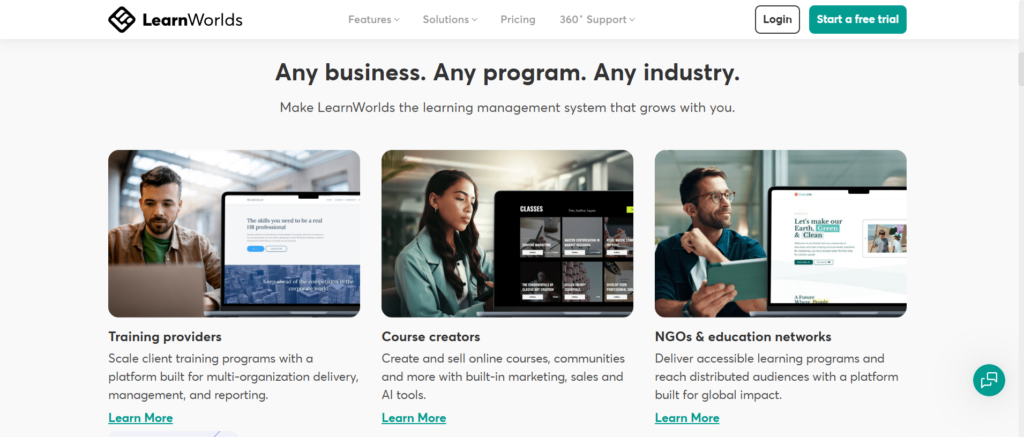
LearnWorlds differentiates itself through interactive video capabilities that very few other platforms can match. You can add quizzes, annotations, hotspots, and branching paths directly within videos, creating learning experiences that go beyond passive consumption. It also supports full SCORM 1.2, SCORM 2004, and xAPI on the Learning Center plan ($249/month annual), making it one of the few creator-adjacent platforms with real compliance capabilities.
Key Features
- Interactive video: Add quizzes, hotspots, annotations, and branching decision paths directly inside video content, which is genuinely unique in the creator platform space.
- SCORM support: Full SCORM 1.2/2004 and xAPI compliance on the Learning Center plan ($249/month annual).
- White-label website: Custom domain, professional templates, and full branding control from the Pro Trainer plan onward.
- AI tools: Course outline generator and landing page builder to accelerate launch timelines.
- 30-day free trial: Available on all plans, which is the most generous trial period among platforms on this list.
How Does LearnWorlds Compare to Kajabi?
| Feature | LearnWorlds | Kajabi |
| SCORM | Yes (Learning Center, $249/mo) | Not supported |
| Interactive video | Yes, industry-leading | Not available |
| DRM | Not available | Not available |
| Branded mobile app | Paid add-on (additional cost) | Pro only ($399/mo) |
| Entry price (annual) | $24/mo (Starter) | $143/mo (Basic) |
| Tx fees | $5/enrollment on Starter, 0% on higher | 0-2% surcharges |
| Marketing funnels | Limited | Yes, strong |
| Community | Yes, built-in | Yes |
| Podcast | Not available | Yes |
Main Differences Between LearnWorlds and Kajabi
- LearnWorlds offers interactive video with in-video quizzes, hotspots, and branching paths. Kajabi does not have this capability.
- LearnWorlds supports SCORM on the Learning Center plan ($249/month). Kajabi does not support SCORM at any price.
- Kajabi has significantly stronger sales funnels, email marketing automation, and podcast hosting tools.
- LearnWorlds charges $5 per enrollment on its Starter plan. Kajabi charges percentage-based surcharges depending on plan and payment method.
Main Similarities Between LearnWorlds and Kajabi
- Both are primarily creator-focused platforms, though LearnWorlds leans more toward learning outcomes than commerce.
- Both lack native DRM content protection.
- Both lack native multi-batch management and sub-organizations for B2B delivery.
- Both offer community features and course builders with multimedia support.
Why Do Companies Use LearnWorlds?
According to G2 reviews (4.7/5), companies choose LearnWorlds for:
- Interactive video: The ability to embed quizzes, hotspots, and branching paths inside video content is consistently cited as the feature that differentiates LearnWorlds from every other platform on the market.
- SCORM for accredited programs: Training providers with certification or compliance requirements appreciate having SCORM support without needing a full enterprise LMS.
- Course builder quality: Reviewers value the intuitive builder interface and the professional quality of the resulting course sites and landing pages.
Bottom Line
LearnWorlds is the strongest Kajabi alternative for creators who prioritize interactive video and need SCORM compliance in Western markets. It lacks DRM, multi-batch management, India-specific payment options, and sub-organization architecture for B2B delivery, which means training businesses with operational complexity will still need to look elsewhere.
5. TalentLMS
Founded: 2012 (Epignosis, Greece)
Most similar to: Docebo, Litmos, Cornerstone
Typical users: HR managers, L&D teams, training managers
Typical customers: Corporate organizations running internal employee training and compliance programs
What Is TalentLMS?
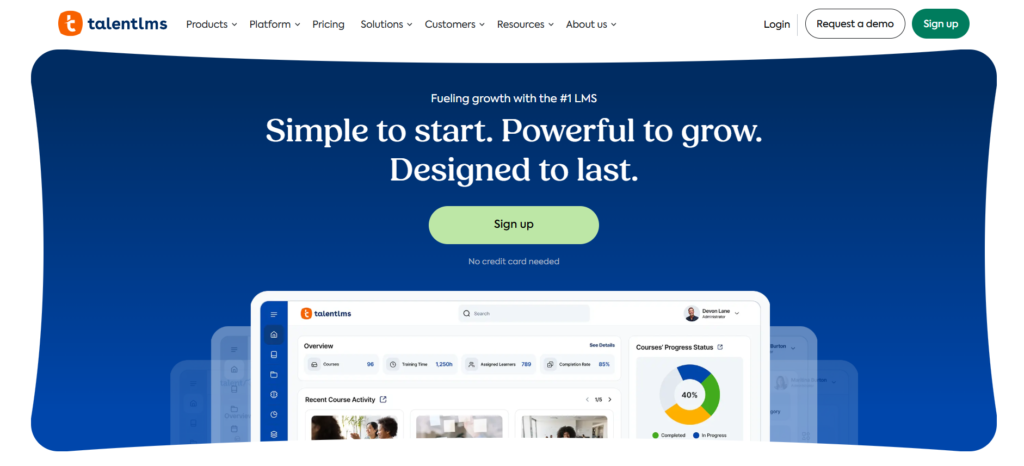
TalentLMS is a fundamentally different kind of platform from Kajabi. While Kajabi is built for selling courses to external audiences, TalentLMS is built for training your employees. It is a corporate L&D tool used by HR and training departments for onboarding, compliance training, and skills development. We include it in this guide because it appears in Google results for ‘Kajabi alternative’ and some training businesses straddle both use cases: selling to external learners while also training internal teams. For a detailed comparison, see our Edmingle vs TalentLMS analysis.
Key Features
- HRIS integrations: Native connections with BambooHR, ADP, and Salesforce for seamless employee data syncing.
- TalentLibrary: A ready-made content library add-on with professionally produced courses for common training needs.
- TalentCraft AI: AI-powered content creation, translation in 40+ languages, and course generation tools.
- Free plan: Available for up to 5 users and 10 courses, which makes it possible to evaluate the platform before committing.
- SCORM support: Available on all paid plans, which is a significant advantage for organizations with compliance requirements.
How Does TalentLMS Compare to Kajabi?
| Feature | TalentLMS | Kajabi |
| SCORM | Yes, all plans | Not supported |
| Primary use case | Internal employee training | Creator course sales |
| HRIS integrations | Yes (BambooHR, ADP, Salesforce) | Not available |
| Marketing funnels | Not designed for this | Yes, strong |
| Per-user pricing | Yes (scales linearly with users) | Flat subscription |
| Free plan | Yes (5 users, 10 courses) | No (14-day trial only) |
| Branded mobile app | Enterprise plans only | Pro only ($399/mo) |
| Community | Limited discussion features | Yes |
Main Differences Between TalentLMS and Kajabi
- TalentLMS is built for internal employee training. Kajabi is built for selling courses to external paying audiences. These are fundamentally different use cases.
- TalentLMS charges per registered user, which means costs scale linearly as your learner base grows. Kajabi uses flat subscription pricing.
- TalentLMS includes HRIS integrations and compliance reporting that are essential for corporate L&D. Kajabi includes marketing funnels and podcast hosting that are irrelevant to employee training.
- TalentLMS supports SCORM on all paid plans. Kajabi does not support SCORM at any price.
Main Similarities Between TalentLMS and Kajabi
- Both offer course creation with multimedia content support.
- Both are self-serve with free or trial options available for evaluation.
- Both have AI-powered content creation features (TalentCraft AI and Kajabi AI respectively).
Why Do Companies Use TalentLMS?
According to G2 reviews (4.7/5, 700+ reviews), companies choose TalentLMS for:
- Fast setup for employee training: Reviewers consistently praise how quickly they can get a corporate training program running, often within hours rather than weeks.
- Responsive support: Multiple reviewers describe support responses as ‘detailed within 24 hours,’ which stands in contrast to the declining support quality reported on some other platforms.
- Ready-made content library: TalentLibrary’s professionally produced courses save significant time for HR teams building compliance, onboarding, and skills development programs.
Bottom Line
TalentLMS is excellent for corporate employee training, onboarding, and compliance programs. It is not designed for training businesses that sell programs to external paying customers. If your use case is internal L&D, it deserves serious evaluation. If you sell courses or training programs to external learners, it will not serve your needs.
6. Podia

Founded: 2014
Most similar to: Teachable, Systeme.io, Gumroad
Typical users: Solo creators, hobbyists, beginners
Typical customers: Individual digital product sellers in the early stages of their creator journey
What Is Podia?
Podia is a straightforward platform for selling courses, digital downloads, coaching sessions, and community access. It removed its free plan in October 2024, replacing it with a 30-day trial. Per the Learning Revolution analysis (April 2026), Podia currently offers two paid plans: Mover ($33/month annual, 5% transaction fee) and Shaker ($75/month annual, 0% transaction fee).
Key Features
- Simple selling: Courses, digital downloads, coaching, and community access from one clean interface.
- Email marketing: Basic email tools included on all plans for communicating with your audience.
- Affiliate marketing: Available on the Shaker plan for partner-driven distribution.
- Beginner-friendly: Designed for creators who want to sell quickly without complex configuration or technical setup.
How Does Podia Compare to Kajabi?
| Feature | Podia | Kajabi |
| Entry price (annual) | $33/mo (Mover) | $143/mo (Basic) |
| SCORM | Not supported | Not supported |
| DRM | Not available | Not available |
| Marketing funnels | Limited | Yes, strong |
| Tx fees | 5% on Mover, 0% on Shaker | 0-2% surcharges |
| Branded mobile app | Not available | Pro only ($399/mo) |
| Community | Yes, included | Yes |
| Podcast | Not available | Yes |
Main Differences Between Podia and Kajabi
- Podia is dramatically cheaper ($33/month entry versus $143/month), making it accessible to creators who are testing the market.
- Kajabi has far stronger marketing automation, sales pipeline tools, email sequences, and podcast hosting.
- Podia’s Mover plan charges a 5% transaction fee. Kajabi’s surcharges are lower (0 to 2%) but more complex and vary by payment method.
- Podia does not offer a branded mobile app at any price. Kajabi offers one on Pro ($399/month).
Main Similarities Between Podia and Kajabi
- Both are creator-focused platforms for selling courses, coaching, and digital products.
- Both include community features as part of the platform.
- Neither supports SCORM, DRM, multi-batch management, or sub-organizations.
Why Do Companies Use Podia?
According to G2 reviews (4.4/5), companies choose Podia for:
- Simplicity: Podia’s interface is deliberately minimal, and reviewers appreciate being able to go from signup to first sale in a single afternoon.
- Speed of setup: The platform requires minimal configuration, which appeals to creators who want to sell immediately rather than spend weeks building.
- Affordable pricing: At $33/month, Podia is one of the cheapest ways to start selling digital products online.
Bottom Line
Podia is ideal for budget-conscious beginners selling simple digital products who want the fastest possible path from idea to first sale. It lacks SCORM, DRM, multi-batch management, and advanced analytics. It is a creator tool for the earliest stage of a digital product business, and training businesses will outgrow it almost immediately.
7. Mighty Networks
Founded: 2017
Most similar to: Circle, Skool, Heartbeat
Typical users: Community builders, cohort-based educators, membership creators
Typical customers: Creator-educators who build community-driven learning experiences
What Is Mighty Networks?
Mighty Networks is a community-first platform where courses exist as a secondary content format. The platform emphasizes member interactions, events, live sessions, and ongoing community engagement rather than traditional course delivery. It is G2’s #1 ranked Kajabi alternative, though it is fundamentally a community tool rather than an LMS.
Key Features
- Native community: Activity feeds, events, member profiles, and interaction tools that form the core of the platform experience.
- Branded mobile app: Available on higher-tier plans with the Mighty Networks brand removed.
- Cohort-based courses: Course delivery within the community context, with start and end dates for structured learning.
- AI features: AI-powered community engagement tools and content suggestions.
- Event hosting: Native live event scheduling and hosting integrated with the community experience.
How Does Mighty Networks Compare to Kajabi?
| Feature | Mighty Networks | Kajabi |
| Community depth | Yes, core platform focus | Yes, but secondary to courses |
| SCORM | Not supported | Not supported |
| DRM | Not available | Not available |
| Branded mobile app | Higher-tier plans | Pro only ($399/mo) |
| Entry price | ~$49/mo (Community) | $143/mo (Basic) |
| Tx fees | 1-3% depending on plan | 0-2% surcharges |
| Marketing funnels | Limited | Yes, strong |
| Course depth | Secondary to community | Primary focus |
Main Differences Between Mighty Networks and Kajabi
- Mighty Networks is community-first with courses as secondary content. Kajabi is courses-first with community as a supporting feature. This architectural difference shapes the entire user experience.
- Kajabi has significantly stronger marketing funnels, email automation, and commerce tools for selling individual courses and memberships.
- Mighty Networks charges a 1 to 3% transaction fees depending on plan. Kajabi’s surcharges range from 0 to 2% depending on plan and payment method.
- Mighty Networks includes branded apps on higher plans as part of the subscription. Kajabi restricts branded apps to the $399/month Pro plan.
Main Similarities Between Mighty Networks and Kajabi
- Both offer course creation alongside community features.
- Neither supports SCORM, DRM, or multi-batch management.
- Both offer branded mobile apps, though at different plan levels.
- Both target creators and educators, though with different engagement philosophies.
Why Do Companies Use Mighty Networks?
According to G2 reviews (4.6/5, 618 reviews), companies choose Mighty Networks for:
- Engaging community features: Reviewers describe the community experience as ‘game-like’ and value the focus on member interaction over passive content consumption.
- Strong company partnership: Multiple reviewers mention feeling supported by the Mighty Networks team, with responsive onboarding and genuine investment in customer success.
- Community-driven learning model: For educators who believe learning happens through peer interaction rather than isolated course consumption, Mighty Networks provides the architecture to support that philosophy.
Bottom Line
Mighty Networks is the best choice for creators building community-driven learning experiences where member interaction is as important as the course content itself. It is a community tool, not an LMS, and it lacks SCORM, DRM, multi-batch management, B2B architecture, and advanced learner analytics.
8. Systeme.io
Founded: 2018
Most similar to: ClickFunnels, Podia, Kartra
Typical users: Solopreneurs, funnel builders, budget-conscious creators
Typical customers: Early-stage creators who need funnels, email, and basic courses in one affordable package
What Is Systeme.io?
Systeme.io combines sales funnels, email automation, course hosting, and basic CRM into one platform at the lowest price point in the market. It offers a genuinely free plan (2,000 contacts, limited features) and paid plans from $27/month. Per the Ruzuku analysis, it is a platform that covers many features at a basic level without excelling in any single area.
Key Features
- Free plan: Genuinely free with 2,000 contacts, 3 membership sites, and basic functionality.
- Sales funnels: Funnel builder with templates, which is the primary reason most users adopt the platform.
- Email marketing: Basic email automation and tagging included on all plans.
- Course hosting: Simple course delivery with basic multimedia support.
- Affiliate management: Included on all paid plans for partner-driven distribution.
How Does Systeme.io Compare to Kajabi?
| Feature | Systeme.io | Kajabi |
| Entry price | Free (2,000 contacts) | $143/mo (Basic) |
| SCORM | Not supported | Not supported |
| DRM | Not available | Not available |
| Marketing funnels | Yes, included | Yes, stronger |
| Course depth | Basic | Moderate |
| Tx fees | 0% | 0-2% surcharges |
| Email automation | Basic | Advanced |
| Podcast | Not available | Yes |
| Branded app | Not available | Pro only ($399/mo) |
Main Differences Between Systeme.io and Kajabi
- Systeme.io has a genuinely free plan with real functionality. Kajabi only offers a 14-day trial that requires a credit card.
- Kajabi’s marketing tools, email automation, and course creation are significantly more polished and capable than Systeme.io’s equivalents.
- Systeme.io charges 0% transaction fees on all plans. Kajabi charges 0 to 2% surcharges depending on plan and payment method.
- Systeme.io’s highest plan ($97/month) costs less than Kajabi’s lowest plan ($143/month), which reflects the substantial quality and feature depth gap.
Main Similarities Between Systeme.io and Kajabi
- Both combine course hosting, email marketing, and sales funnels in one platform.
- Neither supports SCORM, DRM, multi-batch management, or sub-organizations.
- Both include affiliate marketing capabilities.
Why Do Companies Use Systeme.io?
According to Trustpilot reviews and independent analyses, companies choose Systeme.io for:
- The free plan: For creators who are testing a course idea or launching their first digital product, the ability to start for free with real funnel and email capabilities is a genuine differentiator.
- All-in-one at the lowest price: Paid plans from $27 to $97/month include funnels, email, courses, and affiliate management, which is the cheapest combined offering available.
- 0% transaction fees: Unlike most competitors that charge percentage-based fees on lower plans, Systeme.io takes 0% across the board.
Bottom Line
Systeme.io is the best option for budget-conscious creators who need funnels and basic course hosting in one affordable package. Template quality, design polish, support responsiveness, and platform stability are documented concerns across review platforms. It is designed for the earliest stage of a creator business, and training businesses will find its course and analytics capabilities too shallow for operational needs.
9. Learnyst
Founded: 2015
Most similar to: Edmingle, Classplus, Graphy
Typical users: Exam prep educators, coaching institute owners
Typical customers: Single-brand exam prep academies and coaching institutes, primarily in India
What Is Learnyst?
Learnyst is Edmingle’s closest Indian competitor, built specifically for exam prep and coaching academies. Its standout capability is an industry-leading mock test engine that supports exam-specific question types for UPSC, NEET, JEE, CAT, GATE, GMAT, and more. It also offers strong DRM protection with L1/L2/L3 support and a separate Piracy Monitor product. For the full feature comparison, see our Edmingle vs Learnyst analysis.
Key Features
- Mock test engine: Pre-built exam templates for UPSC, NEET, JEE, CAT, GATE, and GMAT with partial marking, multi-input reasoning, leaderboards, and detailed analytics.
- L1/L2/L3 DRM: Comprehensive video protection with Widevine, FairPlay, and PlayReady, plus a separate Piracy Monitor product.
- Branded mobile apps: Android and iOS apps included in plans.
- India-first features: UPI, Razorpay, GST invoicing, and WhatsApp integration.
- Test series as products: Ability to sell mock tests as standalone products separate from course bundles.
How Does Learnyst Compare to Kajabi?
| Feature | Learnyst | Kajabi |
| SCORM | Yes | Not supported |
| DRM | Yes, advanced DRM/L2/L3 + Piracy Monitor | Not available |
| Mock test engine | Yes, industry-leading | Not available |
| Branded mobile app | Included in plans | Pro only ($399/mo) |
| Entry price | $49/mo (~₹3,499) | $143/mo |
| India payments (UPI, Razorpay) | Yes | Not available |
| Marketing funnels | Limited | Yes, strong |
| Community | Yes | Yes |
Main Differences Between Learnyst and Kajabi
- Learnyst has a purpose-built mock test engine with exam-specific templates for Indian competitive exams. Kajabi has no equivalent testing capability.
- Learnyst offers L1/L2/L3 DRM with a separate Piracy Monitor product for active piracy detection. Kajabi lacks any native DRM.
- Learnyst supports Indian payment methods (UPI, Razorpay) and GST invoicing. Kajabi operates exclusively in USD with no India-native payment options.
- Kajabi has significantly stronger marketing funnels, email automation, podcast hosting, and newsletter monetization tools.
- Learnyst’s Business plan ($799/month) is more expensive than Edmingle Power (₹29,999/month) while offering less operational depth for multi-batch and B2B use cases.
Main Similarities Between Learnyst and Kajabi
- Both offer course creation tools with multimedia support.
- Both include branded mobile apps, though Learnyst includes them by default while Kajabi restricts them to Pro.
- Both include community features for learner engagement.
Why Do Companies Use Learnyst?
According to Capterra reviews (4.5/5) and published customer evidence, companies choose Learnyst for:
- Mock test engine depth: Exam prep academies consistently cite the sophistication of mock test question types, leaderboard analytics, and exam-specific templates as the primary reason for choosing Learnyst over alternatives.
- DRM and piracy protection: Content security with L1/L2/L3 DRM and the Piracy Monitor product resonates strongly with educators concerned about unauthorized distribution of their course material.
- Exam-vertical specialization: Pre-built solution pages and templates for UPSC, NEET, JEE, CAT, and GMAT make it easy for coaching institute owners to see immediate fit without extensive customization.
Bottom Line
Learnyst is the right choice for single-brand exam prep academies where mock tests drive the majority of revenue. For broader training businesses with multi-batch, multi-instructor, B2B delivery, or multi-brand requirements, Edmingle offers deeper operational capabilities at a lower top-tier price point (₹29,999/month versus $799/month for Learnyst Business).
Honorable Mentions: Other Kajabi Competitors Worth Knowing
Several other platforms appear frequently across competing ‘Kajabi alternative’ roundups. They did not make our primary list because they are less relevant to training businesses, but they are worth mentioning for completeness.
Circle is a community-first platform similar to Mighty Networks but with a cleaner interface and tighter Zapier integrations. It is popular with membership creators who want community alongside courses. It lacks SCORM, DRM, and multi-batch management, which puts it in the creator category rather than training operations. Pricing starts at around $49/month.
GoHighLevel (GHL) is a marketing automation platform that includes basic course hosting. It is built for marketing agencies managing multiple clients, with CRM, landing pages, funnels, and phone/SMS tools. The course functionality is rudimentary compared to dedicated platforms, and it lacks SCORM, DRM, and learner analytics entirely. Pricing starts at $97/month. Relevant for agencies, but not a serious option for structured training delivery.
Kartra is an all-in-one marketing platform with course hosting, email, funnels, and helpdesk tools. It competes directly with Kajabi on the creator-commerce side but does not offer SCORM, DRM, or training-specific features. Pricing starts at $119/month (annual). It is a reasonable Kajabi alternative for creators who prioritize marketing automation, but training businesses will hit the same operational ceilings they experienced with Kajabi.
Alternative to Kajabi: What You Are Actually Paying vs Kajabi Pricing
Kajabi’s headline pricing obscures significant feature gaps. Here is the full picture across all 9 alternatives:
| Platform | Entry | Mid | Top | Tx Fees | Apps | SCORM |
| Edmingle | ₹7,499/mo | ₹14,999/mo | ₹29,999/mo | 0% | Included (Prime+) | Yes (Prime+) |
| Thinkific | ~$39/mo | ~$74/mo | $149/mo | 0-5% | $199/mo add-on | Plus only |
| Teachable | ~$39/mo | $139/mo | $309/mo | 7.5%* | Not available | No |
| LearnWorlds | $24/mo | $79/mo | $249/mo | $5/sale* | Add-on | LC plan |
| TalentLMS | ~$109/mo | ~$229/mo | ~$399/mo | N/A | Ent. only | Yes, all |
| Podia | $33/mo | $75/mo | — | 5%/0% | Not available | No |
| Mighty N. | ~$49/mo | ~$95/mo | ~$179/mo | 1-3% | Higher plans | No |
| Systeme.io | Free | $27/mo | $97/mo | 0% | Not available | No |
| Learnyst | $49/mo (₹3,499) | $149/mo (₹8,999) | $799/mo (₹49,999) | 0% | Included | Yes |
The total cost of ownership comparison is where the picture gets interesting. Kajabi Pro at $399/month provides a branded app, API access, and strong marketing tools. But it still lacks SCORM, DRM, multi-batch management, and advanced learner analytics. To replicate what Edmingle Power (₹29,999/month) includes natively, a Kajabi user would need to add VdoCipher for DRM, a separate SCORM-compliant LMS, and a standalone analytics tool, pushing the real monthly cost well above $500.
Did You Know? Kajabi’s 0.7% subscription surcharge on every payment plan transaction is documented in their help center but rarely mentioned in competitor comparisons. For a training business running memberships or installment plans at scale, this hidden cost compounds significantly over time. Edmingle charges 0% on all transaction types.
How to Migrate From Kajabi
Switching platforms feels daunting, but the process is more straightforward than most creators expect. Here is a general framework for migrating from Kajabi to any alternative:
Content export: Download your course videos, PDFs, and assets from Kajabi’s file manager. Kajabi does not offer a one-click full export, so you will need to download content module by module. If you have a large library, allocate a day for this step.
Contact and student data: Export your contact list and student enrollment data as CSV files from Kajabi’s People section. Most platforms accept CSV imports for contacts and learner records.
Course structure: Recreate your course outlines on the new platform. This is manual work, but most modern platforms have AI-assisted course builders that speed up the process significantly.
Payment and subscription migration: If you use Stripe directly, your existing subscriptions can often be pointed to the new platform without interrupting active payment plans. If you use Kajabi Payments, you will need to transition subscribers to a new payment processor.
DNS and domain: Point your custom domain to the new platform. This is a simple DNS change that takes effect within 24 to 48 hours.
Edmingle offers dedicated migration assistance on Power and Maxx plans, including content import support, learner data transfer, and CSM-led onboarding to minimize disruption during the switch.
Which Kajabi Alternative Should You Choose?
Here is the decision framework based on your business type and primary need:
Best for training businesses with multi-batch, B2B, SCORM, and DRM needs: Edmingle. It delivers the operational depth that Kajabi structurally cannot provide, at a lower price point (₹29,999/month versus $399/month for top-tier plans), with 0% transaction fees, AI-powered features including a Robust AI Companion, and both INR and USD pricing.
Best for interactive video courses with SCORM in Western markets: LearnWorlds. Its in-video quizzes, hotspots, and branching paths are genuinely unmatched, and SCORM support on the Learning Center plan makes it viable for accredited programs.
Best budget option for solo creators: Thinkific (starting at ~$39/month) for course-focused creators, or Systeme.io (free plan available) for creators who also need funnels and email in one package.
Best for creators frustrated with Teachable pricing: Edmingle if you are a training business, or LearnWorlds if you are a creator who needs interactive learning tools.
Best for corporate employee training and compliance: TalentLMS. It is purpose-built for internal L&D with HRIS integrations, compliance reporting, and SCORM on all plans.
Best for community-first membership creators: Mighty Networks. Courses are secondary to community interaction, which is the opposite of Kajabi’s architecture.
Best for simple digital products on a tight budget: Podia. Minimal setup, minimal complexity, minimal cost.
Best for single-brand exam prep academies: Learnyst. Its mock test engine depth is unmatched for UPSC, NEET, JEE, and similar exam verticals.
Book a free demo to see how Edmingle handles your specific training operations, or start your 7-day free trial to experience it firsthand.


