



Key Takeaways
- For SWDA-funded Registered Training Providers, the shortlist should start with platforms that can demonstrate a current TPGateway-linked workflow. Wizlearn, SmartEdu, TigernixTMS and Tertiary Infotech are the most Singapore-specific options in this comparison.
- For corporate, private-pay and regional training businesses, TPGateway is not the main buying criterion. Edmingle is the strongest fit here for repeat cohorts, B2B client delivery and ASEAN operations, but it does not advertise a native TPGateway integration.
- Disprz and Docebo fit larger Singapore enterprises and regional headquarters, TalentLMS fits smaller teams that want public pricing, and Moodle fits organizations with the technical capacity to own hosting and customization.
- A Singapore LMS and a training management system are not automatically the same thing. Funded providers need the government data path; other buyers should prioritize the learning and operating workflows they actually run.
- As of July 1, 2026, SWDA is Singapore's current skills and workforce agency. Older TPGateway pages and vendor material may still use SSG terminology, so buyers should verify the current integration rather than rely on the label.
- TPGateway deadlines are not universally seven days. General public-training records are commonly due within 14 days after course end, in-house records within 28 days, while the seven-day monthly attendance rule applies to active Mid-Career Training Allowance cases.
The best LMS in Singapore depends first on your operating model. A funded Registered Training Provider needs a verified government data path. A corporate L&D team, private training business or ASEAN regional hub usually cares more about delivery, integrations, pricing and scale.
That split changes the shortlist. Local Singapore platforms are strongest on TPGateway and funded-training administration. Global and regional LMS platforms are generally stronger on learner experience, enterprise integrations, multi-client delivery or cross-border scale.
This list compares 10 platforms by best fit, Singapore-specific requirements, pricing, G2 and Reddit signals, pros, cons and the buyer each product actually suits.
Singapore LMS Rules in 90 Seconds
- SWDA is the current agency: SkillsFuture Singapore and Workforce Singapore merged into the Skills and Workforce Development Agency on July 1, 2026. Legacy SSG wording still appears in older pages and vendor material.
- TPGateway matters mainly for funded RTPs: If government course funding is part of your model, verify the live data path for course runs, enrolment, attendance, assessment and error handling. If it is not, do not let this requirement dominate the LMS decision.
- Know the record windows: Public-training attendance and assessment are generally due within 14 days after course end; in-house training generally has 28 days. The seven-day monthly rule is narrower and applies to active Mid-Career Training Allowance cases.
- TRAQOM and WSQ evidence still matter: Funded providers should be able to retain the records needed for course renewal, assessment history and digital credential workflows without rebuilding evidence manually.
- Keep PDPA practical: Do not use NRIC as an authentication secret. In the demo, focus on role permissions, audit logs, data retention, deletion and where learner data is hosted.
Use this shortcut before reading the list:
| If You Are… | Start With… | Why |
| SWDA-funded RTP | Wizlearn, SmartEdu, TigernixTMS, Tertiary Infotech | Government-linked training operations can affect claims and audit evidence. |
| Corporate or private training business | Edmingle, TalentLMS | Delivery, cohort operations, client experience and commercial predictability matter more. |
| Large enterprise or ASEAN headquarters | Disprz, Docebo, Absorb LMS | Enterprise integrations, governance, skills and regional scale become central. |
| Institution with technical capacity | Moodle | Self-hosting and customization can outweigh SaaS convenience. |
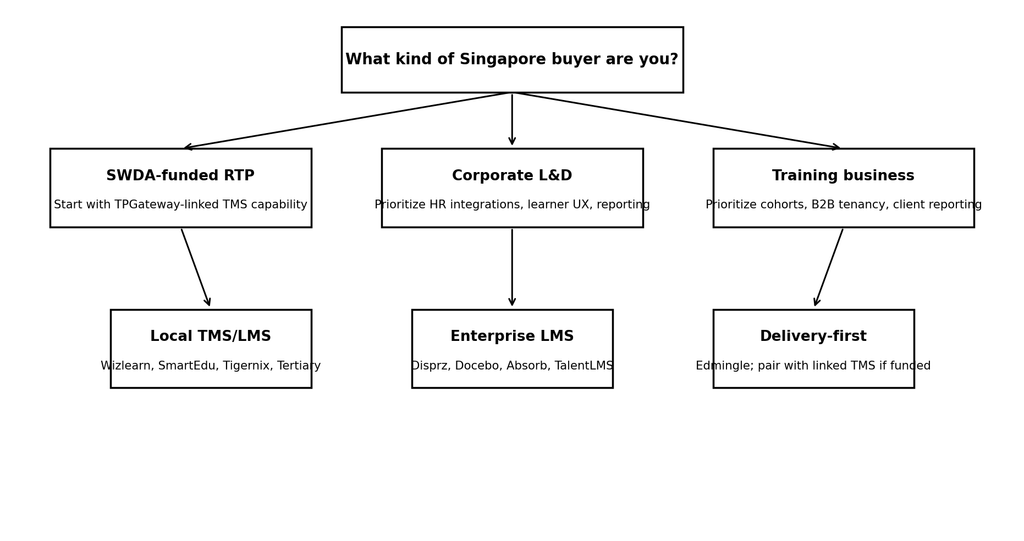
Match the Singapore buyer type to the right platform category before comparing features.
How We Evaluated LMS Vendors in Singapore
We weighted the criteria that change a Singapore buying decision rather than using a generic LMS feature score.
- TPGateway fit: Current government connectivity where funded training makes it relevant.
- Delivery depth: Cohorts, live classes, assessments, certification and learner engagement.
- Buyer fit and regional scale: Whether the platform suits an RTP, corporate team, training business or ASEAN headquarters.
- Data handling: Security controls, permissions, audit logs, hosting and practical PDPA readiness.
- Commercial and review evidence: Pricing transparency plus G2 and Reddit signals where enough independent evidence exists.
10 Best LMS Platforms in Singapore at a Glance
| Platform | Best For | TPGateway / Government Link | G2 | Pricing Signal |
| Wizlearn | Established Singapore RTPs wanting local implementation support | SSG integration documented; SBF directory describes TPG API conformance | No public product rating found | Custom quote |
| SmartEdu | RTPs focused on grant and claims administration | Vendor advertises TPGateway integration and automated submissions | No public product rating found | Custom quote |
| TigernixTMS | Training centers consolidating administration and government data exchange | Vendor advertises TPGateway API connectivity | No public product rating found | Custom quote |
| Tertiary Infotech | RTPs wanting self-hosting and SSG API integration | Vendor advertises out-of-box SSG API / TPGateway integration | No public product rating found | Build/deploy quote; no recurring SaaS fee claimed |
| Edmingle | Corporate, private-pay and regional training businesses; delivery layer beside TMS | No native TPGateway integration advertised | 4.7/5 (8 reviews) | Core $89, Prime $179, Power $349 per month in current listings |
| Disprz | Enterprise skilling across Singapore and Southeast Asia | No TPGateway integration advertised | 4.5/5 (88 reviews) | Custom quote |
| TalentLMS | Small and mid-sized corporate training teams | No TPGateway integration | 4.6/5 (806 reviews) | Core $119/mo annually; higher tiers published |
| Docebo | Large enterprises and regional headquarters | No TPGateway integration | 4.3/5 | Official pages currently conflict: custom pricing page; separate page says $9/user with 250 minimum |
| Moodle | Institutions with technical capacity and data-control requirements | No built-in link; integration can be custom-built | 4.1/5 (448 reviews) | Self-hosted LMS has no license fee; hosting/support cost extra |
| Absorb LMS | Regulated corporate and extended-enterprise training | No TPGateway integration | 4.6/5 (969 reviews) | Custom quote |
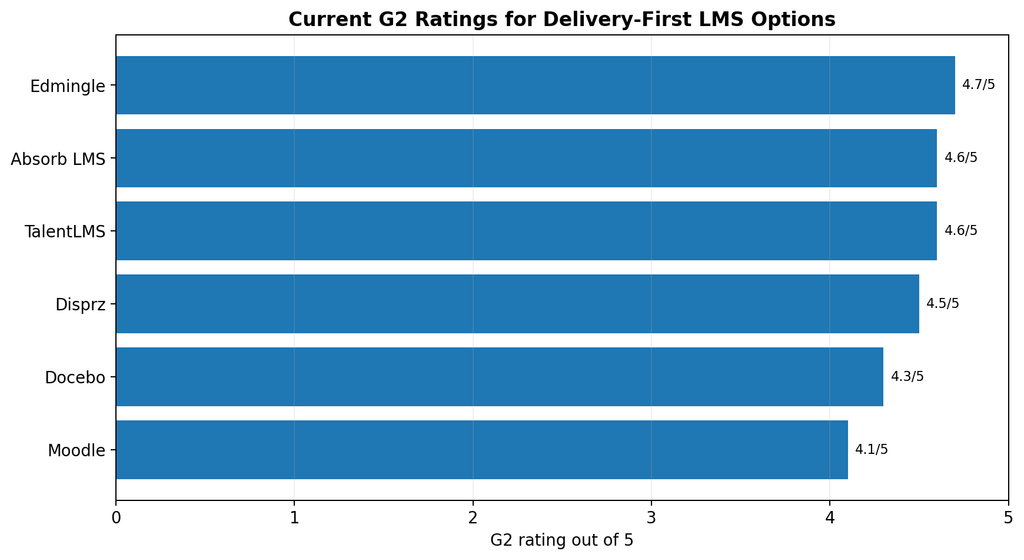
G2 ratings add useful buyer evidence, but Edmingle’s 4.7/5 score is based on only eight reviews and should be read as a small sample.
1. Wizlearn
Best For: Established Singapore RTPs that want a local LMS/TMS partner with documented government integration experience.
Category: Singapore LMS and training management platform
Pricing: Custom quote. An older SBF program brochure listed a package price, but that eligibility period ended in 2025, so it is not used here as current pricing.
Wizlearn is the most established Singapore specialist in this shortlist. The company says it was founded in 2000 as a spin-off from Ngee Ann Polytechnic and the National University of Singapore, and its current product covers learning delivery, class management, attendance, assessments, certificates, registration and reporting.
The important Singapore evidence comes from the Singapore Business Federation directory, which describes Wizlearn’s training and learning management solution as having passed TPG conformance testing and being integrated to TPG through APIs. Because government APIs and agency terminology change, funded RTPs should still ask Wizlearn to demonstrate the current SWDA/TPGateway flow rather than relying on a historical conformance statement.
What Matters in Singapore
- Government integration: Wizlearn lists SkillsFuture Singapore integration as a product capability, and SBF describes 2-way TPG API synchronization.
- Delivery: Face-to-face, video-conference, online and blended delivery are supported alongside attendance and practical-assessment management.
- Local implementation: Singapore-based team and long local track record reduce the distance between product configuration and RTP operating requirements.
- Customization: Wizlearn emphasizes configurable workflows rather than a fixed off-the-shelf setup.
G2 and Reddit Review Signals
No public Wizlearn product rating was found on G2 in current research.
No meaningful independent Reddit discussion about Wizlearn software surfaced.
Pros
- Strongest independent evidence of TPG API conformance among the local vendors in this list.
- Local Singapore support and long history in the training market.
- Combines learning delivery and training administration in one product family.
Cons
- No public current price, which makes early cost comparison slower.
- A heavily customized implementation can create more configuration work than a standardized SaaS product.
- Current SWDA conformance should be demonstrated live because the strongest neutral TPG evidence predates the 2026 agency transition.
Best-Fit Verdict
Wizlearn belongs near the top of an SWDA-funded RTP shortlist when local implementation and a combined delivery/admin stack matter. For a regional training business with little government-funded revenue, compare its learner experience and multi-market structure against delivery-first platforms rather than choosing it for local pedigree alone.
2. SmartEdu
Best For: Singapore RTPs whose bottleneck is grant, course-run and claims administration.
Category: Singapore TMS with LMS capability
Pricing: Custom quote. No current public subscription price was found.
SmartEdu is built around the administrative job a funded Singapore training provider has to complete repeatedly: course runs, enrolments, attendance records, assessment results, subsidies, claims and finance workflows.
Its current site explicitly advertises TPGateway integration and says enrolment, course-run, attendance and assessment submissions can be automated.
What Matters in Singapore
- TPGateway workflow: SmartEdu advertises direct integration for grant submissions and status tracking.
- Training administration: Course management, resource allocation, digital attendance, assessment, invoicing, subsidy tracking and client portals sit in the TMS.
- LMS pairing: SmartEdu also offers an LMS and says the LMS and TMS can be combined.
- Singapore payments and operations: The broader platform includes local payment and accounting integrations designed for training-center administration.
G2 and Reddit Review Signals
No public SmartEdu product rating was found on G2 in current research.
No meaningful product-specific Reddit discussion surfaced.
Pros
- Strong fit when compliance administration is consuming staff time.
- Local product language maps directly to Singapore training-center workflows.
- Can be evaluated as an integrated LMS/TMS rather than an admin-only tool.
Cons
- No public G2 or meaningful Reddit review base for independent user evidence.
- No public pricing.
- Buyer should verify current SWDA API behavior and exception handling rather than relying on the word “automated.”
Best-Fit Verdict
SmartEdu is a practical shortlist option when grant administration is the reason you are buying software. The demo should spend less time on dashboards and more time on failed submissions, missing attendance, resubmission, audit trail and reconciliation.
3. TigernixTMS
Best For: Singapore training centers consolidating fragmented administration and TPGateway-linked workflows.
Category: Training management system with a separate LMS product
Pricing: Custom quote. No current public list price was found.
TigernixTMS positions itself as a Singapore training-management system with TPGateway API connectivity. Its current product documentation covers course data, learner records, Skills Passport-related data, enrolments, assessments and grant administration.
The strongest part of the pitch is centralization. If attendance, assessment and certification records currently live in different tools, a single learner record can improve both operational visibility and the evidence chain used during funding and quality reviews.
What Matters in Singapore
- TPGateway APIs: Tigernix says its platform connects to TPGateway APIs and supports government-linked training workflows.
- Centralized learner records: Attendance, assessment, achievement and program data are managed from one training record.
- Automation: Course, enrolment and grant administration are positioned as workflow automation rather than manual duplication.
- Separate LMS option: Tigernix also sells LMS capability for learning delivery.
G2 and Reddit Review Signals
No public TigernixTMS product rating was found on G2 in current research.
Pros
- Clear focus on the data-fragmentation problem common in training centers.
- Singapore-specific government-system positioning.
- Broader enterprise software background may suit organizations that need adjacent operational systems.
Cons
- No public G2 rating or meaningful Reddit product evidence.
- No public pricing.
- Current TPGateway conformance claims should be verified against a live SWDA-connected customer and actual API transactions.
Best-Fit Verdict
TigernixTMS makes sense when the main failure is duplicated administration across systems. Evaluate its learner-facing LMS separately, because strong backend data flow does not automatically mean the strongest learning experience.
4. Tertiary Infotech
Best For: WSQ RTPs that want SSG/TPGateway integration while owning the deployment and data infrastructure.
Category: Self-hosted LMS and TMS implementation
Pricing: Fixed-fee build and deployment model with optional support. The vendor states there are no per-user or recurring SaaS fees; obtain a current project quote.
Tertiary Infotech takes the opposite commercial approach from a conventional SaaS LMS. Its current 2026 product pages advertise an integrated LMS/TMS for WSQ and TPQA delivery, SSG API integration and self-hosted deployment on the buyer’s infrastructure.
That model changes the cost equation. You avoid per-seat SaaS licensing, but infrastructure, security, backups, upgrades and technical ownership become explicit responsibilities. For an RTP with technical capacity and a strong data-control preference, that can be an advantage. For a small training team without IT ownership, it can become the hidden cost.
What Matters in Singapore
- Self-hosting: Deployment can run in the buyer’s cloud or on-premises environment.
- Government integration: Vendor documentation advertises TPGateway / SSG API flows for course runs, attendance, enrolment, grants and claims.
- WSQ delivery: LMS product includes SCORM/xAPI, assessments, competency tracking and TPQA-oriented evidence.
- Open architecture: The vendor emphasizes open-source components, APIs and buyer control rather than a multi-tenant SaaS subscription.
G2 and Reddit Review Signals
No public Tertiary Infotech LMS/TMS product rating was found on G2.
Reddit discussions that surface for the company are about its training courses, not the LMS/TMS product, so they are not used as software evidence.
Pros
- Strong fit for organizations that want to own infrastructure and data.
- No per-seat SaaS model according to current vendor documentation.
- Built around Singapore WSQ and TPGateway workflows rather than retrofitted after the fact.
Cons
- Self-hosting moves security, uptime and upgrade accountability toward the buyer.
- No public G2 review base and no useful product-specific Reddit evidence.
- Vendor claims of compliance and integration should be validated against current SWDA requirements and an actual production reference.
Best-Fit Verdict
Tertiary Infotech is the strongest control-oriented option in this list. Choose it because you want self-hosting and are prepared to operate it, not simply because recurring SaaS fees look expensive.
5. Edmingle
Best For: Singapore training businesses delivering corporate, private-pay or regional ASEAN programs, and funded RTPs that already have a linked TMS for government submissions.
Category: AI-powered LMS and training operations platform
Pricing: Official US pricing page shows annual billing with 20% savings and taxes additional; current Capterra data lists Core at $89/month, Prime at $179/month and Power at $349/month. Multi-Sub Organizations are marked as an add-on on Power.
Edmingle is a training operations platform built around programs, cohorts or batches, instructor-led delivery, automated attendance, assessments, certificates, branded academies, analytics and multi-tenant B2B delivery. That operating model is relevant to Singapore training companies whose business is delivering training, not simply assigning employee modules.
The Singapore limitation is equally important: Edmingle does not currently advertise a native TPGateway or SWDA integration. An RTP whose economics depend on funded courses should not treat Edmingle as a single-system replacement for the government-linked TMS layer unless a specific integration is scoped and verified. It fits more cleanly for corporate B2B training, private-pay certification, regional delivery, or as the learner-delivery layer beside a linked TMS.
What Matters in Singapore
- Multi-cohort operations: Current pricing documentation includes multi-batch management, unlimited live sessions and automated attendance on Core, with advanced scheduling higher up the plan structure.
- B2B delivery: Power includes Multi-Sub Organizations as an add-on, giving a training business a structure for separate client or market environments.
- AI and analytics: Veda AI and analytics cover learner support, assessment workflows and program-level insights; AI should be evaluated against the exact workflow rather than treated as a generic differentiator.
- Security and controls: Power includes SSO, two-factor authentication and audit logs, which are useful inputs to a Singapore buyer’s PDPA assessment but do not themselves constitute PDPA compliance.
G2 and Reddit Review Signals
G2: 4.7/5
No meaningful independent Reddit product discussion surfaced
Pros
- Strong match for professional training operations, including repeated cohorts and live delivery.
- Published starting prices make commercial evaluation faster than most local and enterprise vendors.
- Multi-tenant B2B structure fits a Singapore headquarters delivering to multiple client organizations or regional markets.
- G2 reviewers repeatedly mention ease of use and support, although the sample is only eight reviews.
Cons
- No advertised native TPGateway/SWDA integration.
- Multi-Sub Organizations are an add-on rather than part of the entry plans.
Best-Fit Verdict
Edmingle is not the “best LMS in Singapore” for every buyer. It is the strongest fit here for a training business where delivery operations, client tenancy and regional scale matter more than direct grant submission. Funded RTPs should pair that delivery value with a currently linked TMS unless a verified integration covers the government layer.
For a Singapore training business, the useful Edmingle evaluation is not a generic course demo. Test the actual operating model: concurrent cohorts, separate client portals, attendance, certification and parent-level reporting.
See Edmingle training operations at scale.
- For B2B delivery across client companies or markets, review customer and partner training and verify the Power-plan Multi-Sub Organizations add-on against your client count.
- AI requirements should be tested against real workflows rather than feature labels. Review Veda AI capabilities.
- For client-ready and cohort reporting, review analytics and outcomes.
- For branding across Singapore and regional client delivery, review branding and professional presence.
- Current plan structure and annual-billing terms are on Edmingle US pricing.
| If your Singapore business already has TPGateway submissions handled, use the Edmingle demo to test the delivery layer you actually want to improve: multi-cohort operations, client separation, attendance, certification and regional reporting. |
6. Disprz
Best For: Large Singapore employers and regional headquarters running skills-based workforce development across Southeast Asia.
Category: AI-powered enterprise skilling and learning suite
Pricing: Custom pricing. No current public global list price was found.
Disprz is an enterprise learning and skilling platform rather than a training-business operating system. Its G2 profile describes a large learner footprint across India, Southeast Asia, the US and the Middle East, which gives it more regional relevance than many North American enterprise LMS products.
For a Singapore corporate L&D buyer, the value is skills architecture, mobile learning, learning journeys and enterprise integration. For a funded RTP, it has the same structural gap as other global platforms in this group: no advertised native TPGateway integration.
What Matters in Singapore
- Skills-led learning: Disprz centers learning around roles, skill gaps and personalized journeys.
- Regional scale: The platform has a substantial Southeast Asia footprint and is designed for large distributed workforces.
- Analytics: Progress, assessments and engagement can be viewed across programs and teams.
- Enterprise integrations: The product is positioned to fit within HR and business-system environments rather than replace a TMS.
G2 and Reddit Review Signals
G2: 4.5/5. Recent reviewers highlight user-friendly learning journeys, centralized program management and progress tracking.
No meaningful independent product-specific Reddit discussion surfaced in current research.
Pros
- Strong Southeast Asia relevance for regional workforce programs.
- G2 reviewers highlight ease of use, centralized tracking and learning journeys.
- Better fit for enterprise skilling strategy than a simple course-management LMS.
Cons
- No advertised TPGateway connectivity for funded provider operations.
- No public list price.
Best-Fit Verdict
Disprz is a credible Singapore enterprise choice when the buyer is HR or L&D and the problem is skills development across a regional workforce. It is not designed around the grant and course-run administration of a funded training business.
7. TalentLMS
Best For: Small and mid-sized Singapore companies that want fast setup, published pricing and a conventional corporate LMS.
Category: Cloud LMS
Pricing: Official annual pricing starts at $119/month for Core (1-40 users) and $449/month for Pro (1-100 users); Grow is published at $229/month in TalentLMS pricing materials. Pricing is in USD.
TalentLMS is one of the easiest global products to budget for before a sales call. Its current pricing page exposes user bands, branch limits, AI features and free-plan details, which is unusually transparent in this market.
For Singapore it works best when government funding is not part of the workflow. Branches can separate teams or audiences, but they are not a substitute for TPGateway-linked funded-training administration.
What Matters in Singapore
- Published pricing: Core starts at $119/month billed yearly; Pro is $449/month and supports 15 branches, with Enterprise for larger deployments.
- Branches: Independent training portals can serve departments, customers or other audiences.
- AI features: Course creation, test generation, translation and AI Coach are part of the current product set.
- Integrations: SSO, API and business integrations fit a corporate stack, but TPGateway is not included.
G2 and Reddit Review Signals
G2: 4.6/5. Current G2 seller/category pages show roughly 800 TalentLMS reviews, with ease of use, setup and course creation recurring as strengths.
Reddit users generally describe TalentLMS as workable and approachable, but discussions also surface cost scaling and information-architecture/admin issues as programs grow.
Pros
- Very transparent pricing and a free plan for initial testing.
- G2 reviewers repeatedly praise ease of use, setup and course creation.
- Useful for Singapore SMEs without a dedicated LMS administration team.
- Reddit has generally positive practitioner comments, including “worked pretty well” and no major red flags in some external-audience use cases.
Cons
- Per-active-user pricing can rise quickly with external or large learner populations.
- Branch counts are capped by plan, which can constrain multi-client training businesses.
- G2 reviewers mention limited customization and reporting friction; Reddit discussions also show that content organization can become messy without governance.
- No TPGateway integration.
Best-Fit Verdict
TalentLMS is a strong first corporate LMS for Singapore SMEs that need training online quickly and do not depend on SWDA-funded workflows. Training providers serving many client organizations should model branch and user growth before choosing it on entry price alone.
For a feature-level Edmingle comparison, see Edmingle vs TalentLMS.
8. Docebo
Best For: Large Singapore enterprises and APAC headquarters that need a sophisticated multi-audience learning platform.
Category: Enterprise AI-powered learning platform
Pricing: Docebo’s pricing page says pricing is customized by tier and active-user model. A separate current Docebo product page says the main tier costs $9/user with a 250-user minimum. Because those official pages conflict, confirm the current commercial model in writing.
Docebo is an enterprise learning platform for employees, customers and partners, with personalization, automation, certification, multi-audience design and a large integration ecosystem. It fits the Singapore buyer that has a real L&D technology function, not a small training provider looking for local grant administration.
The most important commercial detail in September 2026 is inconsistent official pricing language. Docebo’s dedicated pricing page routes buyers to custom pricing by tier and active-user model, while another current product page advertises a $9/user main tier with a 250-user minimum. That inconsistency should be resolved in the quote rather than smoothed over in a comparison table.
What Matters in Singapore
- Enterprise scale: Multi-audience training, white-labeling, automation and analytics suit regional headquarters.
- Active-user pricing: Docebo supports MAU, YAU and RAU models depending on the contract.
- AI: Creator, recommendations and newer AI roleplay/readiness features go beyond basic course generation.
- Integrations: Broad HR, CRM and business-system integrations are a core part of the enterprise value proposition.
G2 and Reddit Review Signals
G2: 4.3/5. G2 highlights usability, management features and customization; setup complexity and missing or add-on functionality recur as concerns.
Reddit administrator discussions are mixed. Some users praise course management and client-page flexibility; others describe admin complexity, reporting friction, extra-cost surprises and time-consuming data export during migrations.
Pros
- Strong enterprise breadth for employee, partner and customer learning.
- G2 reviewers value usability, management features and customization.
- Regional-headquarters fit is stronger than for Singapore-specific grant operations.
Cons
- No native TPGateway integration advertised.
- Official pricing pages currently conflict, so the quoted model needs written confirmation.
- G2 and Reddit both surface setup/admin complexity; Reddit also contains complaints about add-on costs and reporting.
Best-Fit Verdict
Docebo is a serious option for Singapore enterprises running multiple learning audiences from one regional platform. It is overbuilt for many training providers and does not solve the government-linked TMS requirement.
9. Moodle
Best For: Institutions and training organizations with technical capacity that value open source, data control and custom integration.
Category: Open-source LMS
Pricing: Moodle LMS is free open-source software when self-hosted. MoodleCloud and certified hosting/support are paid services; MoodleCloud plans are billed in AUD and can include country-specific taxes.
Moodle is the control option. The LMS software itself has no license fee when self-hosted, and the plugin ecosystem makes almost any integration theoretically possible. That includes a custom government-data connection if an organization has the development capability to build and maintain it.
The cost does not disappear. It moves into hosting, security, upgrades, plugins, integration work and administrator skill. In Singapore, that trade can be attractive for an institution with an IT team and explicit data-residency requirements, but it is a poor bargain for a small provider with no one responsible for the stack.
What Matters in Singapore
- Open source: No license fee for self-hosted Moodle LMS and full source-level customization.
- Hosting choice: Organizations can self-host in Singapore or use MoodleCloud/certified partners.
- Plugin ecosystem: A broad plugin ecosystem covers integrations, activities, reports and assessment extensions.
- Assessment: Moodle remains strong for structured courses, quizzes, competency frameworks and education workflows.
G2 and Reddit Review Signals
G2: 4.1/5. Flexibility, customization and course creation are recurring strengths; complexity and learning curve are the dominant drawbacks.
Recent Moodle administrator discussion mirrors the G2 pattern: course creation can feel straightforward, while HRIS automation, dynamic enrollment rules and enterprise workflows can require more configuration or technical expertise.
Pros
- Maximum control over hosting and data location.
- G2 reviewers value flexibility, customization and the plugin ecosystem.
- Can be extended toward Singapore-specific workflows when technical resources exist.
Cons
- No built-in TPGateway integration in the standard product.
- G2 and Reddit both highlight administrative complexity and a steep learning curve for enterprise workflows.
- Self-hosting makes security patching, uptime and integration maintenance your responsibility.
Best-Fit Verdict
Moodle is economical when the technical capability already exists. If the organization has to hire that capability purely to operate the LMS, compare the full operating cost with managed SaaS rather than treating the license price as the total price.
10. Absorb LMS
Best For: Singapore corporates with compliance-heavy internal or extended-enterprise training and a need for mature support.
Category: Mid-market to enterprise LMS
Pricing: Custom pricing. No current official public list price was found.
Absorb is a broad enterprise LMS for employees, customers and partners, with multi-tenant structures, automation, ecommerce, certification and compliance-oriented reporting. In Singapore it fits regulated corporate training more naturally than SkillsFuture-funded training-provider administration.
The product’s review evidence is deeper than most platforms in this list. That makes its 4.6 rating more meaningful than a similar score based on a handful of reviews, but it still does not answer the Singapore-specific procurement question: TPGateway integration is not part of the standard product.
What Matters in Singapore
- Extended enterprise: Departments and portals can separate audiences and client groups.
- Compliance training: Certification and reporting suit regulated corporate environments.
- Support: G2 gives Absorb unusually strong support scores.
- Automation and AI: The platform includes automation, AI features and a broad corporate training feature set.
G2 and Reddit Review Signals
G2: 4.6/5. Ease of use and support are recurring strengths; reporting, customization and missing-feature limitations appear in G2 summaries.
Reddit evidence is thinner and older than G2, but practitioner threads include positive comments about product improvement and authoring alongside concerns about integrations and extra costs in some implementations.
Pros
- Large G2 evidence base with strong support sentiment.
- Good fit for regulated organizations that need audit-oriented corporate training.
- Multi-tenant capability can support partner and customer programs.
Cons
- No native TPGateway integration advertised.
- Quote-only pricing makes comparison slower.
- G2 summaries mention reporting and customization limitations; Reddit threads also include some concerns about extra costs or integration friction.
Best-Fit Verdict
Absorb is a strong corporate compliance LMS in Singapore, especially where support quality matters. It should not be confused with a TPGateway-linked training management system for funded RTP operations.
LMS Pricing in Singapore in 2026
Singapore buyers mainly face three pricing models: local custom quotes, global SaaS pricing in foreign currency and self-hosted software with no license fee but real operating costs. Compare the billing basis and required add-ons before converting anything to SGD.
| Platform | Current Public Signal | Currency / Basis | Singapore Buyer Note |
| Edmingle | $89 Core, $179 Prime, $349 Power in current Capterra listing; official page shows annual billing and taxes additional | USD flat-rate plans | Confirm GST treatment, FX exposure and the Power add-on for Multi-Sub Organizations |
| TalentLMS | $119 Core; $449 Pro on current annual pricing page; Grow published at $229 in current pricing materials | USD active-user bands | Model monthly active users and branch limits, not just entry price |
| Docebo | Official pages conflict: custom quote page vs $9/user main-tier statement with 250-user minimum | Active-user model | Get the exact SKU, user metric, AI credits/add-ons and implementation in writing |
| Moodle | Self-hosted LMS has no license fee; MoodleCloud is paid | Self-hosted cost or AUD cloud subscription | Include hosting, security, upgrades and internal admin time |
| Wizlearn / SmartEdu / Tigernix / Tertiary | No reliable current public SaaS price used in this comparison | Custom / project quote | Ask whether TPGateway work, migration and support are included |
| Disprz / Absorb | No current public list price | Custom quote | Normalize user definitions, implementation and regional support before comparing |
Singapore GST is 9%. For overseas SaaS, confirm GST treatment and foreign-exchange exposure with finance rather than treating the USD sticker price as the final Singapore cost.
Source: IRAS: GST on remote services
| Quote Normalization: Ask every vendor for the same one-page commercial schedule: base subscription, billing currency, GST treatment, active/registered user definition, client or branch limits, implementation, migration, SSO, API access, support tier, AI usage charges and any TPGateway integration work. |
Singapore LMS Procurement Checklist
- Government workflow: If funding is in scope, make the vendor demonstrate the live TPGateway flow, including failed submissions and resubmission.
- Data and security: Verify NRIC is not used for authentication, then review hosting, permissions, retention, deletion and audit logs.
- Delivery model: Test your real cohort, trainer, assessment, certificate and client-reporting workflow instead of a generic demo course.
- Regional scale: If Singapore is the HQ, test separate markets, client admins and reporting across ASEAN without duplicating the platform.
- Commercial model: Normalize the minimum viable plan, implementation, required add-ons, GST treatment and billing currency.
Which LMS in Singapore Should You Choose?
| If This Describes You | Start With | Why |
| Most revenue comes from SWDA-funded / WSQ delivery | Wizlearn, SmartEdu, TigernixTMS, Tertiary Infotech | Government-linked training operations can affect grant processing and audit evidence |
| You sell corporate or private-pay training in Singapore | Edmingle, TalentLMS | Delivery quality, cohort operations and commercial predictability matter more than TPGateway |
| Singapore is your ASEAN headquarters for training delivery | Edmingle, Disprz, Docebo | Multi-market administration and regional scale become central |
| You are a large corporate with internal L&D | Disprz, Docebo, Absorb | Enterprise integrations, governance, skills and reporting matter most |
| You have technical staff and want control over hosting/data | Moodle, Tertiary Infotech | Self-hosting and customization can outweigh SaaS convenience |
The decision should usually narrow to two or three platforms, not ten. An RTP should eliminate any product that cannot demonstrate the funded-training data path. A private training business should eliminate platforms whose admin architecture makes each new client or cohort a manual project. A corporate buyer should eliminate platforms that cannot connect learning to the rest of the workforce stack.
If you run a Singapore training business delivering corporate, regional or private-pay programs, book an Edmingle demo and bring your real delivery model: number of simultaneous cohorts, client organizations, markets, admins and reports. If SSG/SWDA-funded delivery is part of the mix, bring the TMS architecture too so the boundary is explicit rather than discovered after purchase.


