



Key Takeaways
- Release readiness beats authoring speed: The hard part of product training is not building the first course. It is keeping employees, partners and customers aligned when the product changes.
- Treat version currency as a workflow test: Most LMSs do not advertise native product-version certification. Test how each platform helps you identify learners trained on older material and target the right retraining path.
- Audience structure changes the shortlist: Employees, channel partners and customers often need the same source knowledge with different access, branding, administration and reporting.
- Partner training exposes tenancy limits: If each distributor or client requires a separate environment, the number of portals, branches or tenants can matter more than the course builder.
- Pricing must be modeled on your real plan: Current public pricing ranges from $8 per user per month for 360Learning Team to published flat tiers for Edmingle and active-user tiers for TalentLMS. Several enterprise platforms remain quote-only.
A product release creates a training problem the moment it changes what someone must know to sell, support, implement or use the product. The old course may still be technically complete. The learner may still show as certified. The dashboard may still look healthy. None of those facts prove the person is current.
That is why generic LMS comparisons miss the buying decision. Authoring tools, templates and gamification are useful, but product training has a moving subject. The training system has to support a repeatable path from release information to updated learning, targeted reassignment, evidence of current knowledge and reporting across several audience types.
This guide compares nine product training learning management system (LMS) platforms against that operating problem.
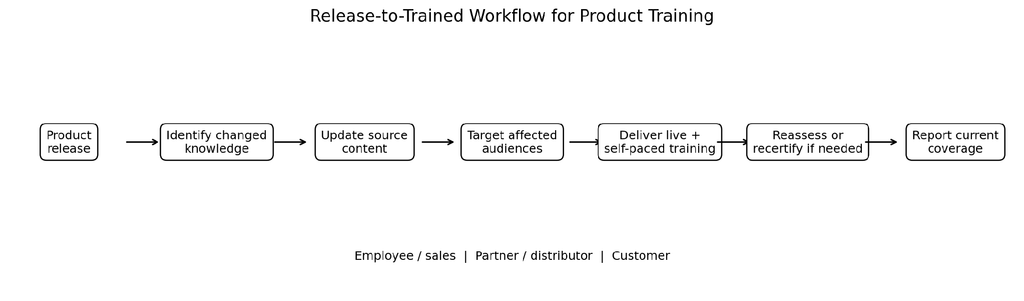
Visual: A product training LMS should support a repeatable release-to-trained workflow across employees, partners and customers.
What Is a Product Training LMS?
A product training LMS is a learning platform used to build and maintain product knowledge for the people who sell, support, implement, distribute or use a product. The learner can be an employee, a reseller, a distributor, a customer or a client organization receiving training from a specialist provider.
- Employees and sales teams: Need fast onboarding to new products, features, positioning and workflows, often with HR or CRM connections.
- Partners and distributors: Need controlled external access, certification, separate administration and evidence that the network is current before it represents the product.
- Customers: Need branded self-service education, product onboarding, entitlement-aware access and sometimes paid certification or advanced training.
A good product training LMS therefore has to do more than host product videos. Depending on the program, the practical requirements include fast content updates, learning paths, audience segmentation, instructor-led sessions, certification, external portals, analytics, APIs, CRM connections and content protection.
Product Training Is a Release-Readiness Problem
Content Can Become Stale Without Becoming Incomplete
A learner can complete every lesson in a course and still hold outdated knowledge after a release. Completion remains useful for proving participation, but product teams also need a way to identify whether the training content itself is still current and who consumed the older version.
Do Not Assume Version-Aware Certification Exists
The original draft treated version-aware certification and release-triggered recertification as standard product capabilities. Current vendor documentation does not support that assumption across this market. Instead, treat it as a workflow requirement and ask each vendor to demonstrate how it would be implemented using course versions, assignments, certification expiry, automation rules, groups, audiences or reporting.
| Demo Test: What Happens After a Release?Edit a product module that 4,000 people have already completed. Then ask the vendor to show which records are preserved, how affected learners are identified, how only the relevant audience is reassigned, what happens to certificates or completions, and how an administrator proves who is current now. |
The Three Audiences of Product Knowledge Training
| Audience | What They Need | What the LMS Must Handle | Common Buying Risk |
|---|---|---|---|
| Employees and sales reps | Fast competence on releases and product changes | Role-based paths, rapid updates, practice, HR/CRM connections | Buying an external-training platform when the real need is internal enablement |
| Partners and distributors | Certification, controlled access and current product knowledge | External portals, partner admins, certification, rollup reporting, content protection | Portal limits, weak client isolation, per-user cost growth |
| Customers | Onboarding, adoption and advanced product education | Branded academy, self-service access, customer data integrations, optional commerce | Employee-first LMS assumptions, weak customer journey reporting |
For a training provider, the model can be more complex. You may be serving all three audiences for several client brands. In that case, the deciding requirement becomes multi-client training operations: separate environments and administrators for each client, plus a central view across every program.
How We Evaluated the Best LMS for Product Training
The shortlist was re-researched on September 1, 2026. We reviewed current vendor documentation for pricing and product capabilities, current G2 ratings, practitioner discussion on Reddit, and the content patterns visible in current product-training LMS rankings.
As a market cross-check, we also reviewed the current eLearning Industry product knowledge LMS roundup, which surfaces several of the same platforms as current product-training searches.
- Update workflow: How quickly subject-matter changes can be reflected in training and reassigned to the right learners.
- Multi-audience delivery: Whether employee, partner and customer audiences can be handled without creating unnecessary platform sprawl.
- Partner or client tenancy: How separate external organizations, admins, branding and reports are handled.
- Certification and reassessment: What exists for certificates, expiry, recertification and targeted reassignment after product changes.
- Live plus self-paced delivery: Whether launch briefings, instructor-led training and self-paced modules can operate together.
- Reporting and integrations: How current knowledge can be segmented and connected to CRM, customer success or other systems.
- Pricing mechanics: Whether costs scale by plan, registered users, active learners or enterprise quote.
- Reviewer evidence: Recurring G2 strengths and cautions plus Reddit signals where enough independent discussion exists.
Edmingle publishes this comparison and appears first. The recommendation is therefore explicit rather than disguised: Edmingle is prioritized for multi-client professional training operations, while competitors are called out where they are a better fit for enterprise consolidation, internal enablement, customer education or collaborative authoring.
Product Training LMS Comparison at a Glance
| Platform | Best For | External Structure | Current Public Pricing |
|---|---|---|---|
| Edmingle | Multi-client product, partner and distributor training | Multi-Sub Organizations on Power, add-on | Core $89/mo; Prime $179/mo; Power $349/mo |
| Intellum | Enterprise customer, partner and employee education | Organizations and audience-specific experiences | Custom quote |
| Docebo | Large enterprise learning across internal and external audiences | Extended enterprise / multi-domain options | Custom quote; active-user model |
| Litmos | Blended external training plus compliance content | Brands and external training | Custom quote |
| Absorb LMS | Extended-enterprise and compliance-heavy programs | Departments / client structures | Custom quote; learner bands |
| LearnUpon | Customer education plus employee and partner learning | Portal-based audience separation | Custom quote; customer education from 300 users |
| Confirm Academy / Learn:Up | Customer or partner academies tied to go-to-market systems | Academy for external audiences | Academy custom; Learn:Up starts $9/user/mo annually |
| 360Learning | Fast collaborative updates by subject-matter experts | Groups and external learning options | Team $8/user/mo up to 100; higher tiers custom |
| TalentLMS | Smaller teams needing published pricing | Branches: 1 Core, 3 Grow, 15 Pro | Core $119; Grow $229; Pro $449/mo billed yearly |
1. Edmingle
Best for: Professional training providers delivering product, partner or distributor programs across several client organizations.
G2: 4.7/5
Edmingle is an AI-powered LMS and training operations platform for professional training and skilling businesses. Its current customer and partner training platform is particularly relevant when product training is delivered to external networks rather than only to employees.
- Multi-client delivery: Power supports Multi-Sub Organizations for B2B delivery as an add-on. Edmingle documents separate branded portals, learners, courses and certificates for partner or customer accounts under one central administration layer.
- Live and cohort operations: Current plans include multi-batch management, unlimited live sessions and automated attendance, with more advanced scheduling higher in the plan structure. This suits launch briefings followed by structured self-paced or assessment work.
- Certification: Current external-network documentation covers automated certificates, expiry and renewal, certificate verification and compliance reporting. These are useful controls for partner programs, but do not assume they automatically map certifications to software release versions.
- Content protection: Edmingle documents multi-layer DRM, dynamic watermarking, screen-capture restrictions and device controls for external product documentation and enablement material.
Its broader training operations layer covers courses, webinars, instructor-led scheduling, multi-cohort delivery, attendance, recordings, assessments and certificates in one operating environment.
For AI-assisted delivery, Veda AI currently covers functions such as course-aware learner support, assessment generation and evaluation, skill-gap analysis and AI interview practice. Those capabilities can speed product-learning workflows, but should remain secondary to the operational requirements that actually determine fit.
Edmingle Pricing
Edmingle offers Core at $89 per month, Prime at $179 and Power at $349, with annual billing discounted versus monthly billing, and multi-sub organizations as a Power add-on.
Reviewer View
- G2 positives: Ease of use and customer support appear most often in the current review tags, with additional positive signals around functionality and implementation ease.
- G2 cautions: The small review set includes isolated comments around troubleshooting, reporting and missing features. With only eight reviews, none should be treated as a broad market consensus.
- Reddit signal: No meaningful independent Reddit discussion about Edmingle surfaced in the current research. That absence is more useful to state than manufacturing a community consensus.
Current Customer Evidence
Edmingle’s current customer stories include certification and high-volume training businesses such as INFS and McGraw Hill Edge. These examples support Edmingle’s professional-training operating story, but they should be treated as adjacent evidence rather than proof of a product-training-specific outcome.
Best Fit and Trade-Offs
Edmingle is strongest when the training business itself must operate product or partner programs across client accounts, with live delivery, certificates, client reporting and proprietary content. It is a weaker choice when the business case depends mainly on a deep native Salesforce or customer-success integration rather than on training operations.
2. Intellum
Best for: Large organizations consolidating customer, partner and employee product education on one enterprise platform.
G2: 4.3/5
Intellum is an enterprise learning platform built around customer, partner and employee education. For product training, the strongest argument is content reuse across several audiences with different learning experiences, supported by certification, analytics, authoring and enterprise integrations.
- Audience consolidation: Useful when one company owns the product and wants a shared education layer rather than separate LMSs for customers, partners and employees.
- Enterprise analytics: The product emphasizes connecting learning data to business outcomes and broader data systems rather than stopping at completions.
- Authoring and certification: Current capabilities include built-in authoring and certification workflows suitable for structured product education at scale.
Pricing
Intellum does not currently publish a global dollar list price.
Reviewer View
- G2 positives: Reviewers commonly point to ease of use, customer support, flexible content experiences and customization for enterprise programs.
- G2 cautions: Search, navigation and limits around customization appear in the current review summaries as recurring friction points.
- Reddit signal: Current independent Reddit discussion is too sparse to support a defensible product-level pro or con.
Best Fit and Trade-Offs
Choose Intellum when enterprise audience consolidation and outcome data matter more than multi-client training-provider operations. A provider delivering training for several unrelated client brands should test client-level separation, administrator hierarchy and commercial tenancy carefully.
3. Docebo
Best for: Large enterprises combining product enablement with broader employee, customer and partner learning.
G2: 4.3/5
Docebo is an enterprise learning platform with extensive AI, personalization, automation and integration capabilities. For product training, AI-assisted content creation and automated enrollment can shorten the operational distance between a release note and a targeted learning path, particularly at large scale.
- AI and content production: Current product packaging includes AI content creation, translation and personalized learning capabilities.
- Automation: Enrollment rules and broader workflow controls help large administrators manage recurring assignment and reassignment processes.
- Enterprise reach: Docebo supports employees, customers and partners, with extended-enterprise options on higher packages.
Pricing
Docebo’s main pricing page remains custom and quote-led, with pricing based on product tier plus active users and MAU, YAU or RAU models. A separate current Docebo page states $9 per user with a 250-user minimum, which conflicts with the main pricing presentation.
Reviewer View
- G2 positives: Users frequently praise the breadth of features, course management, customization and an interface that becomes efficient once configured.
- G2 cautions: Implementation complexity, administration learning curve, missing or paid add-ons and configuration overhead recur in current feedback.
- Reddit signal: Discussion includes complaints about admin clicks, add-on costs and workarounds, balanced by some praise for group handling and platform flexibility.
See the Docebo practitioner thread.
Best Fit and Trade-Offs
Docebo makes sense when product training is one program inside a much broader enterprise learning strategy. It is harder to justify for a smaller external-training business that needs simple multi-client operations and predictable pricing more than enterprise breadth.
4. Litmos
Best for: Organizations combining external product training with compliance content, ecommerce and blended delivery.
G2: 4.3/5
Litmos combines LMS delivery with a substantial off-the-shelf content library and current support for external training, ecommerce, instructor-led and virtual instructor-led training, white-label experiences and multiple brands.
- External training: Useful when customer or partner training sits alongside internal programs and other compliance requirements.
- Blended delivery: ILT and vILT support helps when launch or product certification includes live instruction.
- Content library: The library can reduce build effort for compliance and professional-skills content surrounding the product, although it cannot replace proprietary product knowledge.
Pricing
Litmos currently presents Foundation, Platinum and Platinum AI packages, all on custom pricing.
Reviewer View
- G2 positives: Ease of use, intuitive administration, support and straightforward course creation recur in the current review corpus.
- G2 cautions: Reporting limitations, customization limits and friction around exports or report generation appear repeatedly in current summaries.
- Reddit signal: Recent Reddit results surfaced more evaluation and pricing discussion than detailed post-implementation evidence, so there is not enough signal for a reliable product-level consensus.
Best Fit and Trade-Offs
Litmos is more compelling when product training is part of a broader compliance or workforce-learning program. If proprietary product knowledge is the entire reason for the LMS purchase, the bundled library is useful only for adjacent subjects.
5. Absorb LMS
Best for: Extended-enterprise training and product certification where client separation and compliance reporting matter.
G2: 4.6/5
Absorb LMS supports internal and external learning with hierarchical structures that can separate customer or client populations. Recent G2 reviews specifically mention external portal configuration and multitenancy as useful for organizations selling courseware or managing client branches.
- External portals: Supports customer-facing training and client separation through its organizational structures.
- Certification and compliance: A strong fit when product certification has formal audit or regulatory implications.
- Enterprise administration: Broad administration and reporting capabilities support larger learning populations and several business units.
Pricing
Absorb does not publish a list price. Its current pricing flow asks buyers to select learner bands ranging from 1 to 50 through 25,000+, which signals that population size is a material commercial input.
Reviewer View
- G2 positives: Current reviews highlight user friendliness, support, external portals and multitenancy, including client-specific branches and segregated courseware.
- G2 cautions: Reporting, learning curve and limits in specific customization areas appear in review summaries as recurring caution points.
- Reddit signal: A recent evaluator said they liked Absorb but were concerned about how user-count mechanics could affect fit.
See the Absorb versus TalentLMS evaluation thread.
Best Fit and Trade-Offs
Absorb belongs on the shortlist when product certification is closely tied to compliance and the buyer needs a mature extended-enterprise LMS. Training providers should model learner-band economics against their largest client or partner population, not only their average learner count.
6. LearnUpon
Best for: Mid-market customer education programs that also train employees or partners from one platform.
G2: 4.5/5
LearnUpon supports employee, customer and partner education with portal-based delivery, live learning, certification and recertification, CRM and webinar integrations, APIs, webhooks and ecommerce. That breadth maps well to product training when one company serves several audiences.
- Customer education: The current customer-education offer includes learning journeys, certification, reporting and external integrations.
- Live learning: Useful for product launches, office hours or instructor-led certification that complements on-demand training.
- Implementation support: LearnUpon states that plans include implementation and customer-success support, a meaningful consideration for teams replacing an existing LMS.
Pricing
LearnUpon uses custom pricing. Its current customer-education package starts from 300 users, which gives buyers a clear qualification threshold even without a public dollar amount.
Reviewer View
- G2 positives: Reviewers consistently praise the intuitive interface, responsive support, easy course updates and straightforward customer-learning setup.
- G2 cautions: Limited customization and gaps in specific features recur in current review summaries.
- Reddit signal: In a practitioner vendor thread, a LearnUpon customer described the implementation team very positively and said their rollout could have been completed faster than the six months they used.
See the LMS vendor discussion.
Best Fit and Trade-Offs
LearnUpon is a strong middle ground for a company educating its own customers, partners and employees. A training provider operating separate programs for several client brands should test how far the portal model supports true client-level administration and rollup reporting.
7. Confirm Academy and Learn:Up, Formerly WorkRamp
Best for: Customer and partner academies tied closely to sales enablement, product education and go-to-market systems.
Confirm now positions Academy as its customer and partner education product, while Learn:Up is the broader LMS descended from WorkRamp. For external product training, Academy is the closer functional comparison. The available G2 profile and rating correspond to Learn:Up rather than a separate Academy profile.
- Academy for external learning: Current positioning covers customer and partner education, personalized journeys, branding, certification and analytics.
- Product-update workflow: Confirm Academy explicitly supports building learning from source material such as documents and release notes, making it relevant to fast-moving product education.
- Go-to-market fit: The former WorkRamp product family has a strong historical association with sales enablement and customer education.
Pricing
Confirm Academy is quote-only. Learn:Up currently starts at $9 per user per month billed annually based on a 200-person company.
Reviewer View
- G2 positives: The Learn:Up review set commonly praises course creation, an intuitive interface and responsive support.
- G2 cautions: Reporting depth, automation, branding customization, notifications and analytics appear as recurring improvement areas.
- Reddit signal: Practitioner discussion around WorkRamp has praised responsive support and fit for sales enablement or customer education, while emphasizing that it serves a different operating model from collaborative-authoring tools.
See the WorkRamp and 360Learning discussion.
Best Fit and Trade-Offs
Confirm Academy is a credible choice when product education is tied to customer adoption, sales enablement and external academies. Make sure the demo and quote are for Academy, not assume Learn:Up pricing.
8. 360Learning
Best for: Organizations where product managers and subject-matter experts need to update training directly and quickly.
G2: 4.6/5
360Learning is built around collaborative learning and subject-matter expert authoring. For product training, that design directly addresses one of the biggest delays: the handoff from the person who understands the product change to the instructional-design or LMS team that has to publish it.
- Collaborative authoring: Subject-matter experts can create and update learning content without routing every change through a central production team.
- AI-assisted creation: Current plans include AI-assisted authoring that can reduce first-draft effort for release-driven content.
- Group-based delivery: Useful for targeting product knowledge by role or internal audience, although multi-client tenancy is not its sharpest differentiation.
Pricing
The Team plan is currently $8 per user per month for up to 100 users with no setup fee. Business and Enterprise are custom and can use more flexible registered-user or monthly-active-user models.
Reviewer View
- G2 positives: Ease of use, flexible course building, support, collaborative creation and fast AI-assisted setup recur in recent reviews.
- G2 cautions: Reporting and dashboard depth, customization limits and the need for governance over contributor-created content appear as current caution themes.
- Reddit signal: Practitioner discussion contains some criticism of the sales process and perceived value, which should be treated as anecdotal commercial sentiment rather than evidence about product functionality.
See the 360Learning versus WorkRamp discussion.
Best Fit and Trade-Offs
360Learning is one of the strongest choices when update velocity depends on product experts authoring directly. It is less naturally suited to a training provider that needs separate client organizations, client administrators and strict external content protection.
9. TalentLMS
Best for: Smaller teams that want visible pricing, quick setup and a limited number of external training portals.
G2: 4.6/5
TalentLMS is one of the easiest platforms in this comparison to budget because current pricing and branch limits are public. Branches function as independent training portals, making them relevant to partner or client training until the number of organizations pushes the buyer into a higher tier.
- Published pricing: Current annual-billing entry points are visible without a sales call.
- Branches: Core includes one branch, Grow three and Pro 15, which makes tenancy cost easy to model.
- Standards and integrations: Current plans support common eLearning standards and integrations needed for straightforward product-training delivery.
Pricing
Current annual-billing prices are Core at $119 per month for 1 to 40 users, Grow at $229 for 1 to 70, and Pro at $449 for 1 to 100. Pro currently charges $6 per additional user above 100. TalentLMS also says pricing is based on the different users who log in during the month.
Reviewer View
- G2 positives: Ease of setup, course creation, value, configurability and responsive support appear repeatedly in current feedback.
- G2 cautions: Reporting, customization ceilings and some interface or editor limitations recur in current review summaries.
- Reddit signal: A recent external-audience evaluator reported no major red flags and positive support experience, while an older practitioner thread criticized parts of the UI and editor.
See the TalentLMS pros and cons thread.
Best Fit and Trade-Offs
TalentLMS is a strong fit when a small team needs a working product-training portal quickly. For a training provider, branch ceilings become the binding constraint before core LMS functionality does, so model expected client or partner count before comparing entry prices.
Also Considered in the Current Product Training SERP
Current 2026 product-training rankings also surface Adobe Learning Manager, iSpring LMS and Totara Learn. They were not included in the main nine because this comparison prioritizes platforms with stronger current relevance to external, partner, customer or professional training operations, plus a useful mix of public pricing and enterprise alternatives.
- Adobe Learning Manager: Worth considering for large enterprises already invested in Adobe ecosystems and broad customer or partner learning.
- iSpring LMS: A reasonable shortlist option when PowerPoint-to-course production and straightforward internal product training are major requirements.
- Totara Learn: Relevant for organizations that value configurability and a broader talent or learning ecosystem, particularly when implementation partners are part of the delivery model.
Product Training LMS Pricing in 2026
Pricing becomes misleading when buyers compare only the lowest published number. Product training often needs higher-tier capabilities such as external portals, SSO, certification, CRM integration, SCORM reporting or client administration. The minimum viable plan for your workflow is the number that belongs in the business case.
| Platform | Current Public Pricing | Billing Signal | What to Model |
|---|---|---|---|
| Edmingle | $89 Core, $179 Prime, $349 Power; Maxx custom | Plan-based; annual billing saves 20% on official page | Power add-ons such as Multi-Sub Organizations, taxes, required integrations |
| Intellum | Custom quote | Enterprise subscription based on scope and users | Implementation, integrations, learner definition |
| Docebo | Custom quote; conflicting public FAQ also mentions $9/user, 250 minimum | Tier plus active-user model | MAU/YAU/RAU definition, add-ons, setup |
| Litmos | Custom quote | Foundation / Platinum / Platinum AI | External training, brands, AI tier, implementation |
| Absorb LMS | Custom quote | Learner-band input in quote flow | Largest client population, portals, implementation |
| LearnUpon | Custom quote; Customer Education from 300 users | Audience package and user scale | Portals, integrations, onboarding scope |
| Confirm Academy / Learn:Up | Academy custom; Learn:Up starts $9/user/mo annually | Different products for external vs broader learning | Do not use Learn:Up entry price for Academy |
| 360Learning | $8/user/mo Team up to 100; higher tiers custom | Per user, higher tiers flexible | External audiences, integrations, support tier |
| TalentLMS | $119 Core, $229 Grow, $449 Pro, billed yearly | Monthly users who log in; branch caps by tier | Branches, extra users, required plan features |
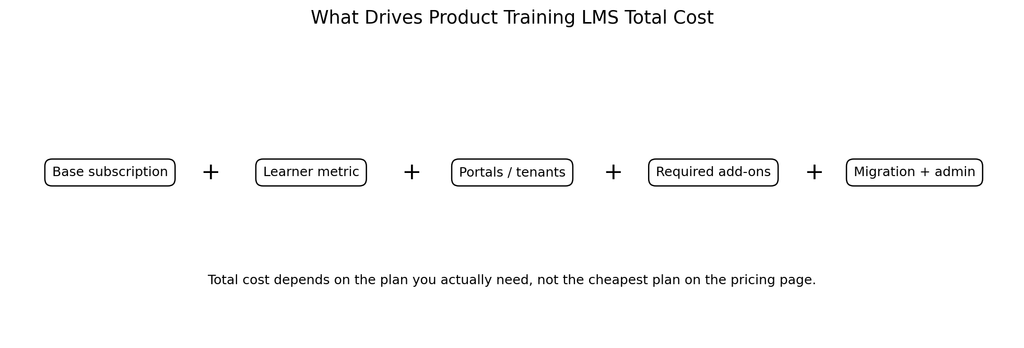
Visual: Product training LMS total cost is driven by the plan you need, learner metric, tenant count, add-ons and migration effort.
| Compare the Plan You Would Actually Buy If partner or client delivery requires Multi-Sub Organizations, SCORM reporting, SSO or advanced analytics, compare the Edmingle tier that contains those capabilities against the competitor tier you would actually sign. Entry-plan comparisons can hide the real cost difference. Compare current Edmingle plans |
Which Product Training LMS Should You Choose?
| Operating Model | Strongest Starting Point | Why |
|---|---|---|
| Training provider serving several client brands | Edmingle | Multi-client training operations, live cohorts, certification, external portals and content protection |
| Enterprise training customers, partners and employees | Intellum | Audience consolidation and enterprise education architecture |
| Large enterprise with broad learning and AI automation | Docebo | Enterprise breadth, automation and active-user models |
| External training plus compliance library and blended learning | Litmos | External training, brands, ILT/vILT and adjacent content library |
| Compliance-heavy extended enterprise | Absorb LMS | External portals, multitenancy and certification depth |
| Mid-market customer education plus other audiences | LearnUpon | Customer education package, portals, live learning and integrations |
| Customer/partner academy tied to go-to-market systems | Confirm Academy | External academy positioning and product-update workflows |
| Fast SME-led content updates | 360Learning | Collaborative authoring and AI-assisted creation |
| Small team with visible pricing and few portals | TalentLMS | Published pricing, quick setup and explicit branch limits |
Eliminate platforms that fail your audience structure, tenancy or pricing requirements first. Then take the same release-day scenario into two or three demos and compare the amount of manual work left after the LMS does its part.
| See Edmingle Against Your Real Product-Training Workflow If you deliver product, partner or distributor training across client organizations, bring one current release scenario, your client hierarchy and your certification requirements to the demo. The useful question is not whether Edmingle has an LMS feature. It is how many operational steps disappear from your current process. Book an Edmingle demo |


